Monday, 18 October 2010

Ride Lonesome (1959)

One of Budd Boetticher's series of westerns starring Randolph Scott and written by Burt Kennedy, Ride Lonesome  is a fine, lean piece of film-making with dialogue as tight lipped as a desert parched cowboy. A typical plot - silent, mysterious loner tracks down a murderer with a bounty on his head to take him back to Santa Cruz to hang, whilst all the while trying to lure the murderers brother into a showdown in revenge for the killing of his wife.  But then you never watch a western for its plot do you?


The action is fast and quick, much like the 50s B-movie production. Burt Kennedy's script is a killer, full of that mid-century American machismo that seemed designed for the movies. Randolph Scott barely moves a muscle throughout the film, keeping his conversation to a minimum, his eyes set on the horizon:

"You mean you’d kill each other over a bounty? Like two dogs fighting over a bone?"

"You could say that."

There's no justification for his actions, no-one tells him he's going to far when he strings up the juvenile murderer and goads his brother on, the one scene were he seems to enjoy himself.
A great film, minimal and restrained and all over in 73 minutes - I'd like more please.


Saturday, 16 October 2010

Cross Fades: Celine and Julie Go Boating (1974) & Mulholland Dr. (2001)


(Cross fades is to be an irregular feature where I critique and compare similar films or books, and hopefully it will become more frequent as I get my act together.)

I happened to order both of these films from sofa cinema within a short period of time and through no conscious choice, but their similarities and shared themes are striking.

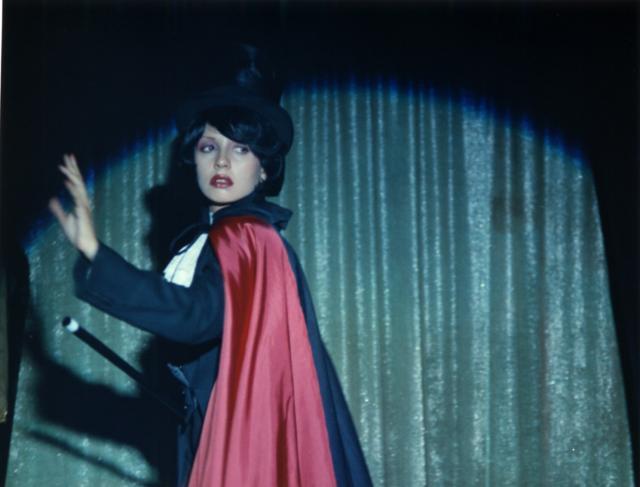
Celine and Julie is my second attempt at Jacque Rivette after Paris nous apartient which was a great surprise when I first watched it. Two women who seemingly meet for the first time strike up a bizaare friendship centred on make-believe. Their lives become increasingly interlinked, leading to some scenes were they live each others life for a brief time without anyone noticing – Celine dons a ginger wig and meets with Julie’s lover; Julie performs Celine’s magic stage show and breaks down in front of a pair of cigar smoking agents. The pair act out their lives as if it’s all a big joke, chasing each other across Paris, inventing wild stories to each other about their day. This sounds wearying, but its all done with a deft light touch and its all very charming for the first hour or so.


Then the pair stumble upon an empty house and events take a strange turn... Listen:

Celine and Julie play the role of a maid in the house, and the house is inhabited by two sisters, one widower and a small child. They play out an over the top melodrama in a constant cycle, Celine or Julie playing the maid and helping the action move on. When they leave the house they are dazed and incoherent and can’t remember any of this. Accept there’s a boiled sweet in their mouths, and when they eat it the memories return and they can recount their adventure.

However, they can only remember small sections of the drama each time, so they have to keep returning to the house to learn more about the story. You see, the child gets murder at the end of the play, but neither Celine of Julie know who committed the murder.


The rest of the film involves the couple solving the murder by piecing together the fragments of the drama into a whole, and then entering the house together and attempting to rescue the child.

This sounds pretty serious, but you won’t think it is when you’re watching the film. There is no atmosphere of foreboding or terror like Mulholland Dr, instead everything is taken in it’s stride. Celine and Julie enjoy the adventure, they concoct in-jokes about the inhabitants of the house and they never question why this is all happening. The house scenes themselves are shot in such brightly lit conditions that it seems almost uncomfortably real, anti-cinematic. The camera is reserved, framing each shot simply and cutting between scenes very quickly. Rivette’s direction throughout is great, not flashy in the slightest but confident enough to keep you from getting bored and moving the action on – quite important for a film were nothing really happens for 3 hours.

The film is a giant metaphor for the experience of watching and engaging in the cinema, and as such forms a nice companion to Mullholland Dr. C & J enjoy the experience, go back to the house to experience it again, get to know the lines, interpret the characters actions, invest their emotions in the drama and eventually manipulate it to their own means. The meta-narrative ‘film-within-a-film’ story is ripe for interpretation and is a favourite of high minded critics and film buffs (David Thompson described it as “the most innovative film since Citizen Kane”). The last 5 minutes after they exit the house are great, the boats gliding over the water being akin to the final shot of geese flying over a lake in Paris nous apartient in its thought-provoking beauty.


However, it is a flawed film and one that is perhaps something of a sacred cow due to its  self-reflexive nature. It is too long. At just over 3 hours long the film had many scene that could easily have been cut at no detriment to the finished product. The breezy silliness of the protagonists started to become irritating towards the second hour, especially the screaming and playground rhyming banter that they converse in exclusively in the last 20 minutes. Brevity seems like such an underrated concept, but its shocking how many at films with seemingly low budgets seem to sprawl out to 3 hours. So much for Hitchcock’s mantra that the length of a film should be directly related to the endurance of the human bladder.

Mulholland Dr was exactly what I expected from David Lynch, which is a strange kind of praise. It stems from my being greatly disappointed by Blue Velvet which is thought was made by Dennis Hopper and seriously flagged whenever he was off screen. Prior to watching Blue Velvet I was expecting Lynch's films to be murky, labyrinthine and unsettling, but Blue Velvet only met the latter.  

Like Celine and Julie..., Mulholland Dr concerns two women who happen upon each other unexpectedly and increasingly rely on each other to interpret events around them. Betty, an ingenué in hollywood trying to make a break, takes on the cause of Rita, the amnesiac she found in her Aunts shower one day. Rita was involved in an accident and she is trying to find out who she is and why she was involved in the accident.

The film is littered with red herrings and false starts, leading the viewer down roads that never go anywhere. This could be due to Lynch originally writing the film as a TV pilot for aseries he had in mind. Purportedly he was knocked back on the proposal and decided to turn the story into a film, keeping most of the multiple strands in the plot. The feeling of 'forces at work' that this generates throughout the film is great and it has to be said that Mulholland Dr has one of the best atmospheres in a fim that I have experienced in a long time. Everything is messed up and potentially symbolic, much like Celine and Julie... excet this time there is a real sense of dread running through the film, especially when the duo discover a disgustingly putrid corpse decomposing on a motel bed that looks strangely familiar... 

From there on the film breaks down and starts again, gradually revealing itself through flashabcks to show us what has happened, why people are suddenly calling Betty 'Diane', and just how warped an obsessive mind can become. 

I really enjoyed it, felt genuinely spooked on several ocassions and found my opinions on the film changing rapidly as time went by. I thought the early Betty scenes were pathetically sentimentally and corny, but at the end of the film you realise they were supposed to be. An extremely subjective film, the direction changes depending on the character involved and their current state of mind.

Again, much has been made of Mulholland Dr, mostoy due to its focus on the seedy side of Hollywood and perceptions of reality, a subject that is integral to cinema. However, a word of caution - try not to read too much into this film. Enjoy it for what it is, let it flow over you - you'll still get it. Its not hard to understand whats happened at the end of the film (it may be during the film, but thats part of the fun), but I think there is a danger of exposing multi-layered films like this as quite superficial if they are unwound too much.

Barry Lyndon (1975)

After a long wait I finally got to watch Barry Lyndon, Kubrick's stately Thackeray adaptation that followed the controversial A Clockwork Orange. Another 3 hour film (what have I done to deserve this?) but strangely enough, despite its slow pace, a film I didn't feel overstayed it's welcome. With a few exceptions the film moved along at a good pace, which can, I assume having never read it, be attributed to Thackeray's source novel. 


Kubrick is often criticised for his impersonal, distanced and cold treatment of his protagonists, never penetrating beneath the veneer or exploring the 'why' of their actions. Strangely, the Bildungsroman form of the film suits Kubrick's style down to a tee, with an entire 20-30+ year period flashing by in 3 hours. You never have the chance to emote with Barry or find out why he is so fly-by-night, but I never got bothered by this, instead getting whisked along by the picaresque adventures of Barry.


Ryan O'Neal is generally held to be miscast as Barry, a barrel chested all-American playing an Irish gentleman made good, but I couldn’t see the problem with his performance. He manages the frustrated, proud young man and the distanced, self-satisfied lord of the manor very well, all using the same technique – by saying and doing very little. Whether this is a masterclass in restrained acting managing to emote inner repression, or just a 'model' actor not doing a very good job at expressing himself I can't say. I can imagine Kubrick was very pleased with the performance.


The shots are beautifully composed, painterly even, with a definite feel of Constable and Gainsborough landscapes to the outdoor scenes – lots of running water, trees overhanging stone walls, horse and carts. Kubrick does a great trick of zooming slowly out from a small detail to reveal a perfectly framed countryside scene, the closest he gets to a swooping period drama camera. The interior shots are remarkable for their lighting, which is all done by candle light (Kubrick reputedly developed/pioneered a special lens for his purpose)..


Where the film does fall down is in some very tedious, overly long scenes with little tension, especially the final duel scene which made me yearn for a Peckinpah style bloodbath to get over the monotonous build up.The film is also fairly predictable, not helped by the narrator who leaves you in no doubt that you are watching a filmed book, as opposed to an adaptation.

Tuesday, 21 September 2010

Riddley Walker by Russell Hoban

Written entirely in a post-apocalyptic, reverted vernacular Riddley Walker proves to be a slow read for a book of just over 200 pages, but such close reading of the text, slowed down as you are by the bizaare slang and allusions peppered throughout, only heightens the impact of the novel. A cliche, but true: you get lost in this book.

Here's a taster of Riddley Speak for the uninitated - the first line:

"On my naming day when I come 12 I gone front spear and kilt a wyld boar he parbly ben the las wyld pig on the Bundel Downs any how there hadnt ben none for a long time befor him nor I aint looking to see none agen."

Obvious first impressions will remind you of A Clockwork Orange, but the language of Riddley Walker is not that of a refined and stylised language, but rather a language of loss and forgotten civilisation. A catastrophe in the past, most probably a nuclear war, has left the world thinly populated and in a state of almost stone age ignorance. Superstition is rife and whatever society there is left interprets their surrounding via the creation/destruction myth of 'Eusa'. This quasi religious legend forms the backbone of a kind of local government, who maintain power and influence by travelling between villages and performing 'Eusa shows'. These shows take the form of a call and response puppet show, where various episodes from Eusa's story is performed and interpreted to fit in with local event, thus allowing the 'Prime Minister' (pry mincer) to spin his events to suit his purpose.

This is the background in which Riddley's tale unfolds, and as I already mentioned, you do get lost in the dirty magnificence of the book. Folk tales, religious philosophising, dirty jokes and a bizaare geography all collide to create a very real world and a rather frightening one at that. Its easy to see the laughable, almso qauint side of distopian fiction, at the bad mindedness and pessimism of the endevour to create a world gone bad. But I could see Riddley Walker happening - humanity would likely survive in some form or other after a major calamity and mankind would need rules and stories to make sense of the world, just as it does today.

Looking at it realistically one must come to the conclusion that Riddley is obviously deluded, that his visions and his personification of Punch are just the imagination of a simple, restricted mind. However, Hoban never lets you take such an objective view of his protagonist - as you read the novel you are overwhelmingly part of Riddley. As such his 'connexions' and 'tels', his inspired Punch rants - seemingly unearthed from a cultural unconsciousness - are real, almost magic or spiritual. Hoban is showing us how a religion is formed in an ignorant world where any answer is better than the unknown. An inspired passage in the middle of the book has the Goodparley character explaining how the unknown word "Saviour" actually refers to salt, as salt is "savery". Such strained associations seem perfectly reasonable in Riddley Walker, where great mythic importance is given to innocuous events or items, simply because some kind of connection can be made between them.

Riddley Walker is a wonderful book, still fresh and vivid, exciting and inspired. Hoban's afterwords and explanation of the genesis of the story (The Legend of St Eustace in Canterbury Cathedral) and his formation of Riddley Speak (the book took 5 years to write, and Hoban claims to have forgotten how to spell after finishing it) are fascinating - try and get hold of the anniversary or expanded editions to read these sections. This is my 3rd Russell Hoban book - I highly recommend the equally lonely, searching Fremder for nother excellent read - but Riddley Walker blows most books out of the water for imagination and audacity.

Monday, 6 September 2010

Bonnie & Clyde (1967)

Arthur Penn's Bonnie & Clyde takes off from the first frame, taking the viewer with it, and doesn't come back down until the the last scene when we come crashing back to Earth, just like the rag doll corpses of our heroes.


This film shows us so much. Thinking back on it now I am astounded at how perfect it was in telling its story without actually telling us anything. An example? The opening scene: Bonnie, naked, pouting in front of a mirror, writhing on her bed and banging the head board with her fist. Immediately we know she is yearning for more, a way out of her dead-end life, her dead end town, her sexual frustration. A lesser film would need an explanatory conversation, a voice-over even: "I was sick of this life and boy did I need a good lay".

Then Clyde walks by, sharp in a tailored suit and fedora. Does this film need a 'cute-meet' as Billy Wilder would say? No, a glimpse of Bonnie through a window suffices for the story to begin.

They rob a grocery store and take off into the country. Upon parking (no pun intended) Bonnie pounces on Clyde but is cast aside. You see Clyde can't get it up - its never explained why this is so, and it certainly doesn't look like a conscious effort on his behalf. Its like their exploits in general: the bank jobs keep adding to their excitement, their driving gets faster, more erratic, their murders more frequent, but there is never a big payoff - where is this all leading to? You feel that if they actually got round to finally having sex then the killing spree might end. But there isn't any climax to this film, just a short sharp let down, the deafening roar of machine gun fire ripping us out of our reverie.

Too many articles focus on how Bonnie & Clyde changed American cinema, a history lesson through celluloid. You could sit through this film and really study its impact on the industry and write a thesis about how the 60s and the bloodletting in Vietnam at the time were as much a part of the film as the dustbowl. But that would be to miss out on what is such a vital film, such entertainment.

You can immerse yourself in the beauty of it, at the nostalgia of the back projection in the cars, at the golden hues of Burnett Guffrey's cinematography, at the chemistry between the two leads - Warren Beatty's goofy smiles, Faye Dunaways childish, glowering moods - the attention to detail (see those corn crops they're running through when Bonnie goes missing? They're poor crops - it's the depression after all), at the whip-crack humour and bawdiness of it all.

Of course there is so much artistic licence in the film - this isn't reality. Bonnie & Clyde apparently met at a friend's house, far less romantic than a glimpse on the street; according to most accounts Bonnie never got into the thick of a fire fight during the life-span of the gang; and the character of Hamer was never captured and humiliated by the gang before he finally managed to gun them down. All this is interesting trivia but pointless criticism. Bonnie & Clyde isn't reality, even though its intensity and passion make us feel that it can only be real life we are watching. Bonnie & Clyde isn't reality- it is pure cinema.

Monday, 23 August 2010

Ikiru (1952)

 
Some back story:

For a while S & I have been working our way through the 'they shoot pictures, dont they' top 100, partly out of interest, mostly out of a sense of ego-fuelled duty (can you call yourself a cineaste if you haven't seen Le Règle du Jeu? Unlikely. Now we have - and it was overated). We knew we wouldn't like all of the films we watched, after all it's a ranking of opinions, but we hoped to really fall for the majority of those on the list. There were revelations (M - amazing; L'atalante - subtle and brilliant), disagreements (The Searchers - didn't find S; The Magnificent Ambersons - not so magnificent for S) and disappointments (Les enfants du paradis? Rio Bravo? and I was really looking forward to Rio Bravo). Then there was Kurosawa, and I still can't decide on how I feel about his films...

Ikiru was the second film after Kurosawa's European breakthrough Rashomon, and it's the 5th Kurosawa films I've seen so far (Rashomon, The Seven Samurai, Kagemusha and Ran being the others). It tells the story of a civil servant, Watanabe, who is nearing retirement. At the beginning of the film Watanabe is diagnosed with terminal stomach cancer. He has devoted his life to his monotous work, refusing to remarry after his wife died and instead raises his son from a distance whilst continuing to plug away at work, never standing out, and earning the nickname 'The Mummy'. The film tells the story of how he comes to terms with his nearing death and his desire to finally make a difference to someone.

The film is well shot with some great crowd scenes when Watanabe is taken on a night out with his "own personal Mephistopholes". The final scene of Watanabe singing in the snow is, regardless of its renown, beautiful. The majority of the film takes place in interiors: homes, bars, offices. You geta real feel of claustrophobia throughout the feel, as if Watanabe's enaring fate is closing in with the walls and piles of office papers. Yet I couldn't quite accept this film and never felt as if Kurosawa showed us anything.

What do you learn about Watanabe? That he should have remarried, that he is a figure of fun at work, that his son resents him. Do we learn anything about why he took this route in life? Well, no. Other than a sense of 'duty' to his son and a desire not to appear needy or special, Watanabe only ever seems to stare forlonly to the left of the camera whenever he is confronted with an unsettling truth. Boy do you get sick of that face...


The film would be a good half an hour shorter if we weren't forced to sit and stare at that face every 10 minutes. And this is were my frustration with Kurosawa can be summed up - where is the subtlety? Where is the ephiphany? I always expect him to be better than Ozu due to his reputation and his subject range, but in terms of an effecting drama about old age and mortality Tokyo Story blows Ikiru out of the water.

Watanabe decides to push through the children's playground proposal - fair enough. But you could see it coming a mile off. The film really lacked any real character progression - Watanabe's world was shattered by his diagnosis, he felt sorry for himself for the vast majority of the film, he got took on a picaresque tour of the city and spent a lot of time with a young women from the office - did he learn anything from them? I never felt that he did. The decision to back the playground wasn't influenced by any of his recent experiences, it was just the first paper on top of the pile.

I liked this film, but it failed to deliver on its promise. I like Kuroswa, but he fails to deliver on his promise.  This is why I can't place him: his films promise everything, but ultimately show us very little.

Welcome

Welcome to Screen Pages, a blog devoted to film and literature.

I watch a lot of films and I'd always like to read more books. I hope to collate all of my thoughts and opinions on film and literature in this blog, so that I can remember exactly why I dislike John Updike, or exactly what film noirs I've seen so that the niggling sense of deja vu I get every time Robert Ryan smirks that smirk or Gloria Grahame gets fresh I can remind myself that it is because I have already seen the film; not because they are all merging into one formulaic, shadow-filled 90 minutes.

So without further ado...