(Cross fades is to be an irregular feature where I critique and compare similar films or books, and hopefully it will become more frequent as I get my act together.)
I happened to order both of these films from sofa cinema within a short period of time and through no conscious choice, but their similarities and shared themes are striking.
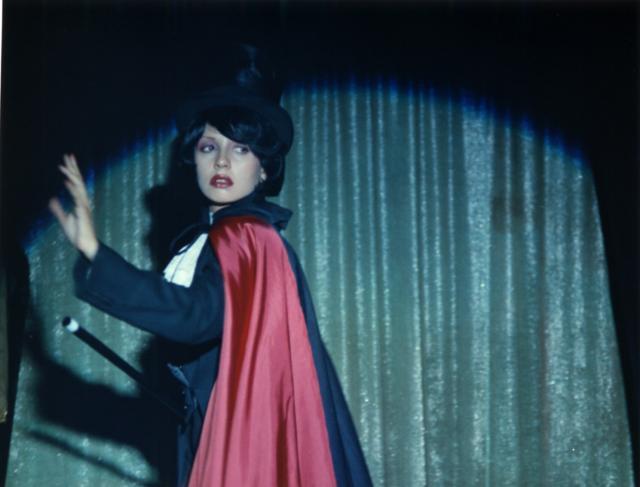
Celine and Julie is my second attempt at Jacque Rivette after Paris nous apartient which was a great surprise when I first watched it. Two women who seemingly meet for the first time strike up a bizaare friendship centred on make-believe. Their lives become increasingly interlinked, leading to some scenes were they live each others life for a brief time without anyone noticing – Celine dons a ginger wig and meets with Julie’s lover; Julie performs Celine’s magic stage show and breaks down in front of a pair of cigar smoking agents. The pair act out their lives as if it’s all a big joke, chasing each other across Paris, inventing wild stories to each other about their day. This sounds wearying, but its all done with a deft light touch and its all very charming for the first hour or so.

Then the pair stumble upon an empty house and events take a strange turn... Listen:
Celine and Julie play the role of a maid in the house, and the house is inhabited by two sisters, one widower and a small child. They play out an over the top melodrama in a constant cycle, Celine or Julie playing the maid and helping the action move on. When they leave the house they are dazed and incoherent and can’t remember any of this. Accept there’s a boiled sweet in their mouths, and when they eat it the memories return and they can recount their adventure.
However, they can only remember small sections of the drama each time, so they have to keep returning to the house to learn more about the story. You see, the child gets murder at the end of the play, but neither Celine of Julie know who committed the murder.

The rest of the film involves the couple solving the murder by piecing together the fragments of the drama into a whole, and then entering the house together and attempting to rescue the child.
This sounds pretty serious, but you won’t think it is when you’re watching the film. There is no atmosphere of foreboding or terror like Mulholland Dr, instead everything is taken in it’s stride. Celine and Julie enjoy the adventure, they concoct in-jokes about the inhabitants of the house and they never question why this is all happening. The house scenes themselves are shot in such brightly lit conditions that it seems almost uncomfortably real, anti-cinematic. The camera is reserved, framing each shot simply and cutting between scenes very quickly. Rivette’s direction throughout is great, not flashy in the slightest but confident enough to keep you from getting bored and moving the action on – quite important for a film were nothing really happens for 3 hours.
The film is a giant metaphor for the experience of watching and engaging in the cinema, and as such forms a nice companion to Mullholland Dr. C & J enjoy the experience, go back to the house to experience it again, get to know the lines, interpret the characters actions, invest their emotions in the drama and eventually manipulate it to their own means. The meta-narrative ‘film-within-a-film’ story is ripe for interpretation and is a favourite of high minded critics and film buffs (David Thompson described it as “the most innovative film since Citizen Kane”). The last 5 minutes after they exit the house are great, the boats gliding over the water being akin to the final shot of geese flying over a lake in Paris nous apartient in its thought-provoking beauty.

However, it is a flawed film and one that is perhaps something of a sacred cow due to its self-reflexive nature. It is too long. At just over 3 hours long the film had many scene that could easily have been cut at no detriment to the finished product. The breezy silliness of the protagonists started to become irritating towards the second hour, especially the screaming and playground rhyming banter that they converse in exclusively in the last 20 minutes. Brevity seems like such an underrated concept, but its shocking how many at films with seemingly low budgets seem to sprawl out to 3 hours. So much for Hitchcock’s mantra that the length of a film should be directly related to the endurance of the human bladder.
Mulholland Dr was exactly what I expected from David Lynch, which is a strange kind of praise. It stems from my being greatly disappointed by Blue Velvet which is thought was made by Dennis Hopper and seriously flagged whenever he was off screen. Prior to watching Blue Velvet I was expecting Lynch's films to be murky, labyrinthine and unsettling, but Blue Velvet only met the latter.
Like Celine and Julie..., Mulholland Dr concerns two women who happen upon each other unexpectedly and increasingly rely on each other to interpret events around them. Betty, an ingenué in hollywood trying to make a break, takes on the cause of Rita, the amnesiac she found in her Aunts shower one day. Rita was involved in an accident and she is trying to find out who she is and why she was involved in the accident.
The film is littered with red herrings and false starts, leading the viewer down roads that never go anywhere. This could be due to Lynch originally writing the film as a TV pilot for aseries he had in mind. Purportedly he was knocked back on the proposal and decided to turn the story into a film, keeping most of the multiple strands in the plot. The feeling of 'forces at work' that this generates throughout the film is great and it has to be said that Mulholland Dr has one of the best atmospheres in a fim that I have experienced in a long time. Everything is messed up and potentially symbolic, much like Celine and Julie... excet this time there is a real sense of dread running through the film, especially when the duo discover a disgustingly putrid corpse decomposing on a motel bed that looks strangely familiar...
From there on the film breaks down and starts again, gradually revealing itself through flashabcks to show us what has happened, why people are suddenly calling Betty 'Diane', and just how warped an obsessive mind can become.
I really enjoyed it, felt genuinely spooked on several ocassions and found my opinions on the film changing rapidly as time went by. I thought the early Betty scenes were pathetically sentimentally and corny, but at the end of the film you realise they were supposed to be. An extremely subjective film, the direction changes depending on the character involved and their current state of mind.
Again, much has been made of Mulholland Dr, mostoy due to its focus on the seedy side of Hollywood and perceptions of reality, a subject that is integral to cinema. However, a word of caution - try not to read too much into this film. Enjoy it for what it is, let it flow over you - you'll still get it. Its not hard to understand whats happened at the end of the film (it may be during the film, but thats part of the fun), but I think there is a danger of exposing multi-layered films like this as quite superficial if they are unwound too much.


