Showing posts with label 1970s. Show all posts

Wednesday, 23 February 2011

Bring me the head of Alfredo Garcia [1974]


"There's nothing sacred about a hole in the ground... or the man that's in it."

Films that have a reputation for their shocking content often fail to live up to expectations, especially those films that managed to isolate and disturb audiences of 30-40 years ago. The final salvo of machine-gun fire in Bonnie & Clyde still opens your eyes, but surely the most shocking aspect of that films now is that it still carries an 18 certificate? A Clockwork Orange's violence and rape seems tame, almost comical, compared to scenes portrayed on the primetime cop shows of today. It is, sadly, the same for Bring me the Head of Alfredo Garcia. Yet even though the 21 deaths of the film may not seem so bloody to today's audiences the film is still notable for its dream-like progress and its portrait of a man's unswerving ability to see a bloody job through.


Oates plays Bennie, a piano player in a tourist trap cantina in Mexico, bashing out the same old standards on the keys for tips and drinks, 'Viva Zapata' scrawled on his jacket. Alfredo Garcia (or 'Al' as Bennie calls his decapitated and rotting head) was a womaniser who got the wrong girl pregnant. El Jefé, the father of the girl, doesn't take well to this and pledges $1,000,000 to whoever brings him Garcia's head. Bennie takes up the challenge, knowing that Al is already dead from a car crash, and sets out to chop the old boy's head off, taking his courtesan girlfriend (and ex-squeeze of Al's) with him. These fellas are the one's who set Bennie on the trail of Garcia's head....


They're supposed to be hard-cases, but they look like somebodies pervy uncle from the 70s.


It's one hell of an amoral film. Bennie is sick of his bullshit life. "I wanna go somewhere new", he says "This time I'm going up". Whether or not he gets there is another question. The increasingly frequent deaths build up to a crescendo in El Jefé's mansion where Bennie seems to achieve some kind of rehabilitation through violence, a gun in one hand, a case full of money in the other.


(Bennie before and after a rather painful exhumation and burial...)


Oates is brilliant, it is his film, even if he does simply deliver his best Peckinpah impersonation. Only a character actor of such good calibre could play such a lowdown character and manage to squeeze out a few drops of empathy and humanity from Bennie. He is ruthless and unscrupulous, but don't you just want him to succeed and get away with it all? When Kris Kristofferson's biker threatens Bennie's girl with rape you seethe with anger and itch for Bennie to start the bloodshedding. But when it comes it all seems so easy, so pre-determined, as if all of that suspense in such an excellent other-wordly scene bled out of the frame the moment the action started. Bennie points and shoots. The man dies. Move on. Bennie was never in danger. Repeat. 

All violence in the film is offhand: there are no major repercussions, no strenuous grapples or tense gunfights. Bennie obviously isn't a seasoned gunfighter, yet he never fails to gun everyone down with ease. His easy progress makes the film feel like a revenge fantasy where all the bad guys get killed with the littlest amount of effort, the protagonist moving on, seeking out more goons and haters, determined to blow all adversaries away. It is very distancing to the viewer and it's hard to tell if this atmosphere was intended. However, the dreamy atmosphere is there, and as you watch this picture it seems to transcend its thriller constraints and move into the realms of existentialism. You want to see how far Bennie will go, how isolated from society and civilisation he will become, how far he can follow his own whims and emotions, not constrained by regret or distaste, simply exercising his desire for revenge and his ability to realise it.


Many critics at the time of the film's release claimed it was one of the worst films ever made. I suspect this is mostly due to the graphic content, but if this criticism was levelled at the lack of suspense in such a violent, morbid film, then I can understand where they were coming from. However this is not to detract from the strange glory of the film. The lack of suspense and  always-certain progress of Bennie's fates raises what could be simply a duff action revenge thriller into a druggy, angry atmosphere piece well worth viewing. Don't expect to be compelled by this film. Instead allow yourself to be taken along in Bennie's wake. It will wash over you like a wave of blood.


Tuesday, 15 February 2011

The Man Who Fell To Earth [1975]


If ever there was a man born to play an alien it was David Bowie.

Roeg cast Bowie whilst The Thin White Duke was at the height of his cocaine addiction: deathly thin, red shock of hair and living on a diet purportedly consisting only of glasses of milk. Bowie is as much a character in the film as 'Thomas Newton'. He was a celebrity androgyne who seemed separate to the overwhelming excess of the 70s modern world, but was actually wholly part of it. The same is true of Newton, the alien who falls to Earth, exuding naivety and innocence, yet strangely knowledgeable and intent on corporate conquest.


There is no escaping how strange this film is: it raise more questions than it answers. Newton's plans for space travel seem to peter out, the motives of his business enemies remains vague, the parallel lives of Newton and the scientist Nathan Bryce (Rip Torn) never quite converge. Instead the alien images of Earth seem to offer some sort of explanation - but what? Roeg, ever the exquisite photographer, gives us moonscape deserts, washed out slag heaps and clinical interiors; all scenes of extra-terrestrial life, yet situated here on Earth.


The story is slim: Bowie's alien is on a mission to acquire water for his drought ravaged home planet. He has learned of Earth through intercepting our TV transmissions. He arrives with money and knowledge of exactly how to set up a corporate monopoly on scientific advances only he knows of. Rip Torn is a womanising academic who's life seems connected to the fortunes of Newton. Along the way Newton is distracted and corrupted by drink, women, TV (lots of it), guns, and money.


Was the film meant to be shallow? Perhaps. The synopsis above is quite a spoiler, yet it is 3 sentences long. At times it is like the most tongue in cheek moments in a Godard film: the Americans are very American, so much so that the film seems like a pastiche or attack on American cultural vandalism. The TVs, the adverts, the greed, drink and fast food: We are all Americans now. But we knew that already.

The films seems to disintegrate at the end after so many orgies, moments of hysteria and strange sex scenes. Did anyone in a Nicholas Roeg film ever actually fuck? If you were confused by the bizarre elbow-chewing wrestling match Donald Sutherland and Julie Christie performed in Don't Look Now then you ain't seen nothin' yet.


I apologise if this makes little sense. The film is so odd, so compelling, it can only be approached elliptically. At the end you kind of feel like Newton, confronted with a series of images bombarding you, yet you remain impassive and strangely compelled. Could Bowie have managed such impassivity without the numbing effects of coke? Who cares. Its a great film. Watch it. I'm going to listen to Station to Station.


Monday, 22 November 2010

The Parallax View (1974)

Part of Alan J Pakula's 'Paranoia Trilogy' (along with Klute and All The President's Men). The plot focuses on Warren Beatty's reporter and his attempt at uncovering a shadowy organisation that seems to specialise in political assassinations. The opening scene sees  popular (democrat?) Presidential candidate being shot in the Seattle space needle by one of the waiters. The shooter runs up to the top of the needle and then manages to act falling off the edge really badly....


Obvious allusions to Bobby Kennedy are present, but it doesn't detract from the immediacy of the shooting which really does make you jump in your seat. Although the film was released 6 years after Bobby Kennedy and Martin Luther King Jr's murders it still successfully conveyed the sense of confused panic that pervaded the 70s: a feeling I felt recently when watching Olivier Assayas's Carlos.


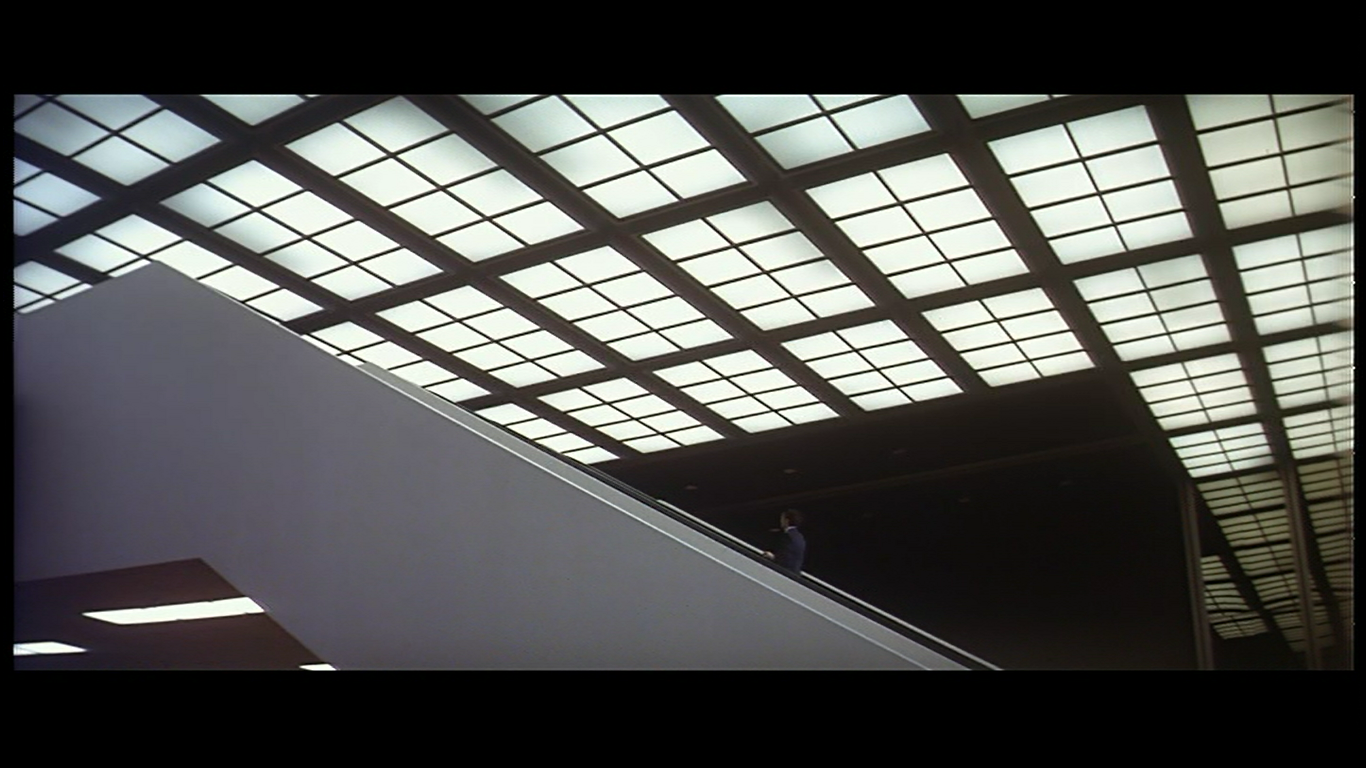
The film was a gift for the DOP - loads of widescreen exterior scenes with forbidding modernist architecture, and dimly lit, labyrinthine interiors.


Warren Beatty played a good roaming journalist trying to uncover the reason why all of the witnesses to the initial assassination have died in suspicious circumstances. This involved a lot of snooping through drawers, talking to psychoanalysts with chimpanzees on their lap, getting into one hell of a contrived bar room brawl and subsequent car chase, and then more snooping around in imposing office blocks...


I'm not sure it's the minor masterpiece that some hold it up to be. Much of the atmosphere of the film was simply that - atmosphere: no payoff. And for as much as I enjoy ambiguous scenarios I would like to have had a little more insight into why the Parallax organisation were killing people, and who, if anyone, employed them. Without any rigorous intellectual questions the lack of further explanation of the plot does feel like a kop-out. Antonioni could have made it better.... In fact he did with Blow-up and The Passenger.


Monday, 8 November 2010

Network (1976)

Another mid 70s American film. There's something about that grainy, washed out film stock and the convergence of fading Hollywood stars and young upstarts that really appeals.

Network is a much talked about film, mainly due to the frenzied rages of Peter Finch's doom-mongering newscaster Howard Beale and his cry of 'I'm mad as hell and I'm not going to take it anymore!' He's fired from the network due to failing viewing figures, but after he announces he' going to kill himself on air the figures start to climb. The network, desperate for the share of the audience eggs him on, puts him on prime time with a blank canvas and the nation becomes hooked on the ravings of this late middle-aged man who has got sick of the bullshit.


Then there is leather faced William Holden who plays his old boss and the only person who seems to have his interests at heart. He's having a fling with Faye Dunaway's ambitious programming director, who in turn takes advantage of Finch's rants and put him centre stage on the networks listings.
Robert Duvall puts on his bombastic, face rubbing act and really attacks the screen with his bullish network chief. An opportunist with some killer lines ("That's a big fat, big titted hit!") Duvall is the best thing in the film next to Finch.


Paddy Chayefsky won the Oscar for his screenplay and deservedly so. Its a stagey, overwritten and unrealistic script, but one that is suited to such an outrageous scenario. You could never accuse Network of realism. Insider jokes abound: especially funny are the programme pitches Dunaway has to sift through every morning, most of which involve a "crusty yet benign older man working with a brilliant, beautiful woman. S pointed out that this could equally be said of Dunaway and Holden - whether this was deliberate irony or just sloppy writing, I couldn't help seeing their relationship as the weak link, a magnet to get ticket sales at a time when Faye Dunaway was a big box office draw. 


Lumet excels at this kind of picture, withdrawn and observant, allowing his actors range to express themselves (or overact) and somehow managing to make great entertainment out of a bunch of cold characters. An enjoyable and highly prescient film, it seems that there has never been a time since its release that Network could not be held up as a mirror to the current era's television addiction.

Saturday, 16 October 2010

Cross Fades: Celine and Julie Go Boating (1974) & Mulholland Dr. (2001)


(Cross fades is to be an irregular feature where I critique and compare similar films or books, and hopefully it will become more frequent as I get my act together.)

I happened to order both of these films from sofa cinema within a short period of time and through no conscious choice, but their similarities and shared themes are striking.

Celine and Julie is my second attempt at Jacque Rivette after Paris nous apartient which was a great surprise when I first watched it. Two women who seemingly meet for the first time strike up a bizaare friendship centred on make-believe. Their lives become increasingly interlinked, leading to some scenes were they live each others life for a brief time without anyone noticing – Celine dons a ginger wig and meets with Julie’s lover; Julie performs Celine’s magic stage show and breaks down in front of a pair of cigar smoking agents. The pair act out their lives as if it’s all a big joke, chasing each other across Paris, inventing wild stories to each other about their day. This sounds wearying, but its all done with a deft light touch and its all very charming for the first hour or so.


Then the pair stumble upon an empty house and events take a strange turn... Listen:

Celine and Julie play the role of a maid in the house, and the house is inhabited by two sisters, one widower and a small child. They play out an over the top melodrama in a constant cycle, Celine or Julie playing the maid and helping the action move on. When they leave the house they are dazed and incoherent and can’t remember any of this. Accept there’s a boiled sweet in their mouths, and when they eat it the memories return and they can recount their adventure.

However, they can only remember small sections of the drama each time, so they have to keep returning to the house to learn more about the story. You see, the child gets murder at the end of the play, but neither Celine of Julie know who committed the murder.


The rest of the film involves the couple solving the murder by piecing together the fragments of the drama into a whole, and then entering the house together and attempting to rescue the child.

This sounds pretty serious, but you won’t think it is when you’re watching the film. There is no atmosphere of foreboding or terror like Mulholland Dr, instead everything is taken in it’s stride. Celine and Julie enjoy the adventure, they concoct in-jokes about the inhabitants of the house and they never question why this is all happening. The house scenes themselves are shot in such brightly lit conditions that it seems almost uncomfortably real, anti-cinematic. The camera is reserved, framing each shot simply and cutting between scenes very quickly. Rivette’s direction throughout is great, not flashy in the slightest but confident enough to keep you from getting bored and moving the action on – quite important for a film were nothing really happens for 3 hours.

The film is a giant metaphor for the experience of watching and engaging in the cinema, and as such forms a nice companion to Mullholland Dr. C & J enjoy the experience, go back to the house to experience it again, get to know the lines, interpret the characters actions, invest their emotions in the drama and eventually manipulate it to their own means. The meta-narrative ‘film-within-a-film’ story is ripe for interpretation and is a favourite of high minded critics and film buffs (David Thompson described it as “the most innovative film since Citizen Kane”). The last 5 minutes after they exit the house are great, the boats gliding over the water being akin to the final shot of geese flying over a lake in Paris nous apartient in its thought-provoking beauty.


However, it is a flawed film and one that is perhaps something of a sacred cow due to its  self-reflexive nature. It is too long. At just over 3 hours long the film had many scene that could easily have been cut at no detriment to the finished product. The breezy silliness of the protagonists started to become irritating towards the second hour, especially the screaming and playground rhyming banter that they converse in exclusively in the last 20 minutes. Brevity seems like such an underrated concept, but its shocking how many at films with seemingly low budgets seem to sprawl out to 3 hours. So much for Hitchcock’s mantra that the length of a film should be directly related to the endurance of the human bladder.

Mulholland Dr was exactly what I expected from David Lynch, which is a strange kind of praise. It stems from my being greatly disappointed by Blue Velvet which is thought was made by Dennis Hopper and seriously flagged whenever he was off screen. Prior to watching Blue Velvet I was expecting Lynch's films to be murky, labyrinthine and unsettling, but Blue Velvet only met the latter.  

Like Celine and Julie..., Mulholland Dr concerns two women who happen upon each other unexpectedly and increasingly rely on each other to interpret events around them. Betty, an ingenué in hollywood trying to make a break, takes on the cause of Rita, the amnesiac she found in her Aunts shower one day. Rita was involved in an accident and she is trying to find out who she is and why she was involved in the accident.

The film is littered with red herrings and false starts, leading the viewer down roads that never go anywhere. This could be due to Lynch originally writing the film as a TV pilot for aseries he had in mind. Purportedly he was knocked back on the proposal and decided to turn the story into a film, keeping most of the multiple strands in the plot. The feeling of 'forces at work' that this generates throughout the film is great and it has to be said that Mulholland Dr has one of the best atmospheres in a fim that I have experienced in a long time. Everything is messed up and potentially symbolic, much like Celine and Julie... excet this time there is a real sense of dread running through the film, especially when the duo discover a disgustingly putrid corpse decomposing on a motel bed that looks strangely familiar... 

From there on the film breaks down and starts again, gradually revealing itself through flashabcks to show us what has happened, why people are suddenly calling Betty 'Diane', and just how warped an obsessive mind can become. 

I really enjoyed it, felt genuinely spooked on several ocassions and found my opinions on the film changing rapidly as time went by. I thought the early Betty scenes were pathetically sentimentally and corny, but at the end of the film you realise they were supposed to be. An extremely subjective film, the direction changes depending on the character involved and their current state of mind.

Again, much has been made of Mulholland Dr, mostoy due to its focus on the seedy side of Hollywood and perceptions of reality, a subject that is integral to cinema. However, a word of caution - try not to read too much into this film. Enjoy it for what it is, let it flow over you - you'll still get it. Its not hard to understand whats happened at the end of the film (it may be during the film, but thats part of the fun), but I think there is a danger of exposing multi-layered films like this as quite superficial if they are unwound too much.

Barry Lyndon (1975)

After a long wait I finally got to watch Barry Lyndon, Kubrick's stately Thackeray adaptation that followed the controversial A Clockwork Orange. Another 3 hour film (what have I done to deserve this?) but strangely enough, despite its slow pace, a film I didn't feel overstayed it's welcome. With a few exceptions the film moved along at a good pace, which can, I assume having never read it, be attributed to Thackeray's source novel. 


Kubrick is often criticised for his impersonal, distanced and cold treatment of his protagonists, never penetrating beneath the veneer or exploring the 'why' of their actions. Strangely, the Bildungsroman form of the film suits Kubrick's style down to a tee, with an entire 20-30+ year period flashing by in 3 hours. You never have the chance to emote with Barry or find out why he is so fly-by-night, but I never got bothered by this, instead getting whisked along by the picaresque adventures of Barry.


Ryan O'Neal is generally held to be miscast as Barry, a barrel chested all-American playing an Irish gentleman made good, but I couldn’t see the problem with his performance. He manages the frustrated, proud young man and the distanced, self-satisfied lord of the manor very well, all using the same technique – by saying and doing very little. Whether this is a masterclass in restrained acting managing to emote inner repression, or just a 'model' actor not doing a very good job at expressing himself I can't say. I can imagine Kubrick was very pleased with the performance.


The shots are beautifully composed, painterly even, with a definite feel of Constable and Gainsborough landscapes to the outdoor scenes – lots of running water, trees overhanging stone walls, horse and carts. Kubrick does a great trick of zooming slowly out from a small detail to reveal a perfectly framed countryside scene, the closest he gets to a swooping period drama camera. The interior shots are remarkable for their lighting, which is all done by candle light (Kubrick reputedly developed/pioneered a special lens for his purpose)..


Where the film does fall down is in some very tedious, overly long scenes with little tension, especially the final duel scene which made me yearn for a Peckinpah style bloodbath to get over the monotonous build up.The film is also fairly predictable, not helped by the narrator who leaves you in no doubt that you are watching a filmed book, as opposed to an adaptation.