The Servant [1963]
Interesting yet slightly underwhelming class drama, directed by Joseph Losey. Remember reading a great article in Sight & Sound about the Joseph Losey/Harold Pinter collaborations and this seemed to stand out for its potential. Great dialogue alright, and many awkward, absurd moments (particularly the bizaare ball game Bogarde and Fox play together towards the end of the film) that set the film apart from its contemporaries, but it was mired by too much 60s zaniness, especially the debauched ending. Brilliantly directed though, confined angles and hidden viewpoints all in one house. Bogarde was great as well.
Night and the city [1950]
Why didn't anyone tell me that this film revolved around the London wrestling circuit of the 50s? A tense thriller it wasn't - Richard Widmark, normally so venal and terse, was flouncing around like a bratty teenager and I couldn't help but laugh at the wrestling scenes. Bear hug him Gregorius! Silly film.
Lift to the scaffold [1957]
Disappointing Louis Malle film, made me realise why Malle is so often disregarded. A slightly contrived premise, but nevertheless one that could work with enough suspence: Jeanne Moreau gets her lover to murder her rich husband, he forgets to clean up the scene of the crime and returns, only to get stuck in the lift when the building is locked up for the night. Mostly revolved around Moreau (who I often find dull and underwhelming anyway) wandering around the city reflecting on whether her lover has ran away at the last minute. Also contained a ridiculous side plot focuses on a young couple who steal the lover's car and get into various kinds of trouble. Didn't make me pine for more.
Tuesday, 14 December 2010

My Night At Maud's [1969]

First Rohmer film, and one that I have been waiting to watch for years. Managed to catch it at the Manchester Cornerhouse's Sunday Matinee which is always worth keeping an eye on.
Jean Louis Trintignant is a wound up Catholic with something against Pascal, and he has to stay the night in Francois Fabian's bed - only he has promised to remain celibate until he marries the pretty blonde who he has been checking out at Sunday Mass.
Pretty weird set up, but an enjoyable film nonetheless. Unrepentantly intellectual, I'll admit most of the discussions on Pascal went over my head. However, after a bit of post film explantion from S I started to understand the plot's analogies with Pascal's wager: Trintignant saw that he had everything to gain and nothing to lose by devoting himself to marriage with the pretty blonde, but I'm not quite he was convinced of this, especially considering the brief coda to the film when his memories and regrets seemed to wash over him like the nearby tide.

A beautifully photographed film (courtesy of Nestor Almendros, who also shot Days of Heaven - one of my personal favourites), every frame seemed to evoke repression (cold landscapes, icy streets) or clarity (simple interiors, the warmth of the church) - a reflection of Trintignant's emotions? Trintignant again displays his mastery of repressed urges: not as creepy as The Conformist or Three Colours: Red, but a calm, gentle and assured performance.
Heavy on the dialogue as it is, one never feels short changed by the film - this isn't a staged script, but a demonstration of how discussion and spoken thought can be cinematic when done properly.
Sunday, 5 December 2010
Thoughts on Heroes
The heroes of Ride The High Country - these old, decrepit men doing a dirty job in a thankless world - seem far more real, far more sympathetic than today's crop of superheroes and supermen. Why is this? Am I alone in finding modest, self reliant outsiders far more charismatic and engaging than Spiderman, Jason Bourne or any of the cast members of Avatar? Here's my two penny's worth...
The events of the first sixty years of the 20th century showed us that the actions of one man can't explain the events of history (something Tolstoy mentions repeatedly in War and Peace, which I'll get around to blogging about when I finally finish it...). Two world wars, the depression, the cold war, Korea, Vietnam - all were monumental occurrences that where the backdrop to all forms of art from 1900 - 1960. Yet, it seems to me at least, that the protagonists and heroes of popular film in the first half of the century always seemed to be concerned with more personal, intimate forms of heroism. The effect on human lives of these seemingly immovable, unavoidable shifts in history is far more engaging and illustrative of the human condition than any story of some all powerful super-human fighting machine, who not only saves himself and the girl but manages to keep the course of history running smoothly, never letting it invade the lives of the little people down below.
What I find remarkable is that the popular entertainment of the time - westerns, noir, even musicals - embodied this feeling of personal heroism and victory and remained immensely popular. You can still find such films today, but they tend to be small independently produced affairs with very little distribution. The audience, it would seem, has tired of modest heroism. (Either that, or, star struck by the spectacle of increasingly preposterous CGI and galactic heroism, audiences flock to the next blockbuster which inevitably costs ten times as much as a small picture like Ride the High Country to produce. Subsequently the next big film has to be hyped up as much as possible to generate revenue and ticket sales, with all that time and money being invested in relatively few films. I think I'm digressing from my original point....)
This could go some way to explain the decline of the western form (as well as noir and musicals - who can save the world with a dance?). The West is a hermetic landscape, very little changes, and if too much is changed then it ceases to be a western. No cowboy could save the world - the most he can hope for is to end the rule of a ruthless cattle baron or local hoodlum. But then, couldn't we? Corporations and politicians have been brought down by ordinary individuals. Gangsters and criminals have been stopped by local heroes. These things can and do happen and when represented on screen or on the page they provide so much more fulfillment and entertainment than a vacuous metal suit flying through the air.
The events of the first sixty years of the 20th century showed us that the actions of one man can't explain the events of history (something Tolstoy mentions repeatedly in War and Peace, which I'll get around to blogging about when I finally finish it...). Two world wars, the depression, the cold war, Korea, Vietnam - all were monumental occurrences that where the backdrop to all forms of art from 1900 - 1960. Yet, it seems to me at least, that the protagonists and heroes of popular film in the first half of the century always seemed to be concerned with more personal, intimate forms of heroism. The effect on human lives of these seemingly immovable, unavoidable shifts in history is far more engaging and illustrative of the human condition than any story of some all powerful super-human fighting machine, who not only saves himself and the girl but manages to keep the course of history running smoothly, never letting it invade the lives of the little people down below.
What I find remarkable is that the popular entertainment of the time - westerns, noir, even musicals - embodied this feeling of personal heroism and victory and remained immensely popular. You can still find such films today, but they tend to be small independently produced affairs with very little distribution. The audience, it would seem, has tired of modest heroism. (Either that, or, star struck by the spectacle of increasingly preposterous CGI and galactic heroism, audiences flock to the next blockbuster which inevitably costs ten times as much as a small picture like Ride the High Country to produce. Subsequently the next big film has to be hyped up as much as possible to generate revenue and ticket sales, with all that time and money being invested in relatively few films. I think I'm digressing from my original point....)
This could go some way to explain the decline of the western form (as well as noir and musicals - who can save the world with a dance?). The West is a hermetic landscape, very little changes, and if too much is changed then it ceases to be a western. No cowboy could save the world - the most he can hope for is to end the rule of a ruthless cattle baron or local hoodlum. But then, couldn't we? Corporations and politicians have been brought down by ordinary individuals. Gangsters and criminals have been stopped by local heroes. These things can and do happen and when represented on screen or on the page they provide so much more fulfillment and entertainment than a vacuous metal suit flying through the air.
Ride The High Country (1962)
Like most Peckinpah films Ride The High Country was concerned with men of action unable to come to terms with a changing world. Much like The Wild Bunch it was set at the beginning of the 20th century when the West had been won and law and order were becoming regulated. The opening scenes neatly sum up the changes as Joel McCrea rides in to town, only to be hurried along by a uniformed policeman and nearly ran over by a 'horseless carriage'. The West is starting to mythologise itself:, demostrated by Randolph Scott, dressed up like Wild Bill Hickock and running a fixed shooting gallery. The two heroes are all but relics, trying to make a dollar any way they can.


The film was shot 7 years before The Wild Bunch. As such there is not as much glorious, vibrant violence in the film and the story is a more recognisable western - two heroic riders, one young greenhorn, riding through the high country to a dangerous big payoff. The themes and motifs that make you feel comfortable are here, but there is a definite sense of loss and unease at the way things now are. The mining town scenes are ingrained with dirt and hedonism, the treatment of women is harsh and misogynistic. Peckinpah always leaves a bitter taste after his scenes with women - was he merely showing us what it would have been like, or were his misogynistic characters a sign of a deeper contempt in the director?


Definitely one of the more thoughtful westerns with a script loaded with nostalgia and questions of morality and heroism. Scott's old timer is still drawn to money, especially after decades in the wilderness, his sentiment of 'You can't take pride with you to the grave' contrasting sharply with McCrea's statement that all he wants is to "enter my home justified". Its also a very beautiful film, shot in a big, wide, heavily wooded country and filled with memorably dramatic scenes of nature - especially the windswept, hillside shootout.


There is a lot to Peckinpah. Indeed there is a wealth of literature to read up on, most of it raising very valid points. One of the more pithy and to the point examples is Christine Gledhill's appraisal of the film in The Cinema Book (BFI, 2007):
"The question [Peckinpah] poses is, how can the traditional code of the western survive into an era when the certainties that underpin it have been eroded? Individual morality has been replaced by corporatism, greed and cynicism [...] in Peckinpah's films, the white male hero is subjected to a series of ordeals, moral and physical that test to the full his ability to retain his integrity and sense of self. Typically, Peckinpah's heroes cannot adjust to a world that has overtaken them. There is no community that they can relate to, only, if they are lucky, a few kindred souls, doomed like them to assert their defiance in acts of heroic resistance."
A nice explanation. But I was wondering what she meant by "an era when the certainties that underpin it have eroded". Does she mean the era represented in the film, or the era of the audience? This started me thinking: has our perception of the hero changed, or have the movies simply stopped showing us these modest men and women? Read my next entry....
Monday, 22 November 2010
Leningrad Cowboys Go America [1989]

A great little film, and obviously a little weird and precious. There are some wonderful visual gags (see the cowboy's nailing their winkle pickers back so that they can put their foot on the accelarator pedal) and the music made the film. Kaurasmaki has a unique perspective on cinema, one that has developed from oddball movies like this to the more restrained, contemplative recent films such as The Man Without a Past. I look forward to seeing more.

The Parallax View (1974)
Part of Alan J Pakula's 'Paranoia Trilogy' (along with Klute and All The President's Men). The plot focuses on Warren Beatty's reporter and his attempt at uncovering a shadowy organisation that seems to specialise in political assassinations. The opening scene sees popular (democrat?) Presidential candidate being shot in the Seattle space needle by one of the waiters. The shooter runs up to the top of the needle and then manages to act falling off the edge really badly....

Obvious allusions to Bobby Kennedy are present, but it doesn't detract from the immediacy of the shooting which really does make you jump in your seat. Although the film was released 6 years after Bobby Kennedy and Martin Luther King Jr's murders it still successfully conveyed the sense of confused panic that pervaded the 70s: a feeling I felt recently when watching Olivier Assayas's Carlos.

The film was a gift for the DOP - loads of widescreen exterior scenes with forbidding modernist architecture, and dimly lit, labyrinthine interiors.


Warren Beatty played a good roaming journalist trying to uncover the reason why all of the witnesses to the initial assassination have died in suspicious circumstances. This involved a lot of snooping through drawers, talking to psychoanalysts with chimpanzees on their lap, getting into one hell of a contrived bar room brawl and subsequent car chase, and then more snooping around in imposing office blocks...
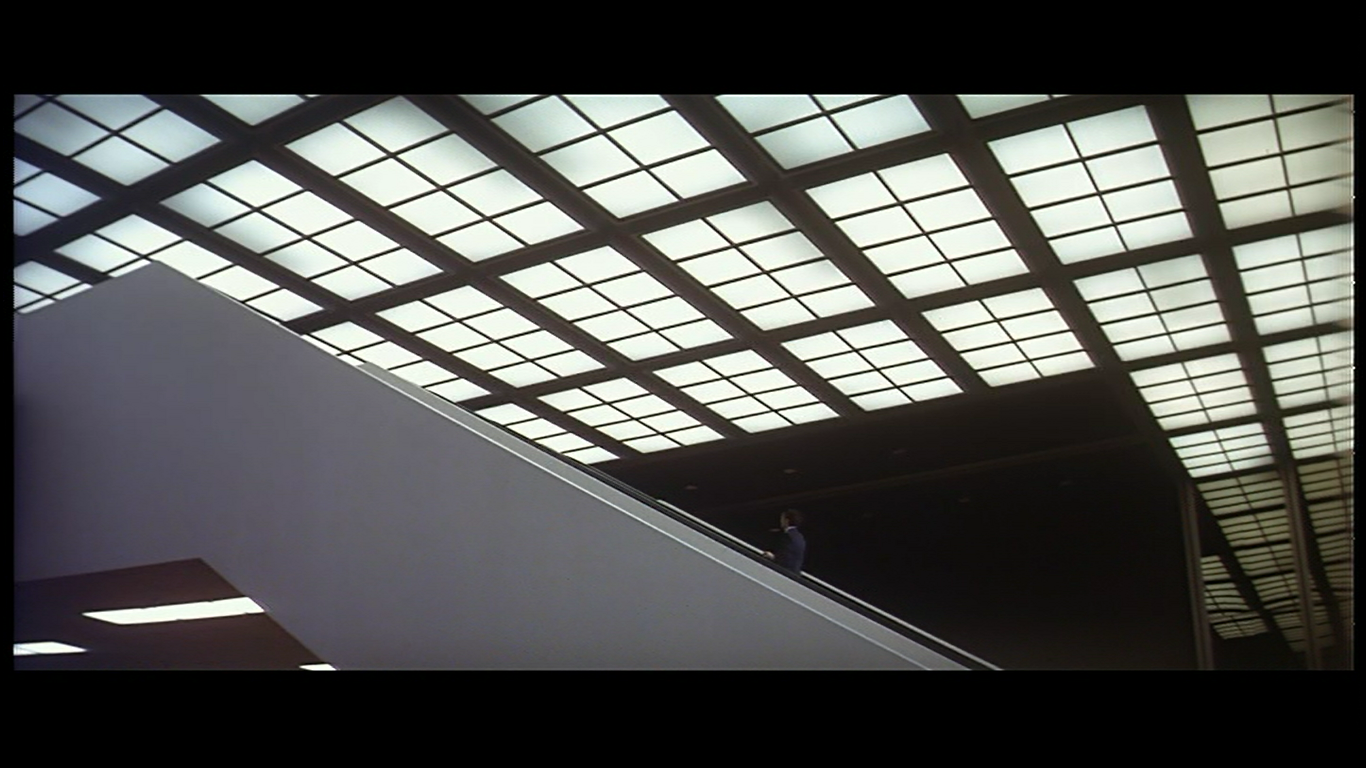
I'm not sure it's the minor masterpiece that some hold it up to be. Much of the atmosphere of the film was simply that - atmosphere: no payoff. And for as much as I enjoy ambiguous scenarios I would like to have had a little more insight into why the Parallax organisation were killing people, and who, if anyone, employed them. Without any rigorous intellectual questions the lack of further explanation of the plot does feel like a kop-out. Antonioni could have made it better.... In fact he did with Blow-up and The Passenger.

Monday, 8 November 2010
Network (1976)
Another mid 70s American film. There's something about that grainy, washed out film stock and the convergence of fading Hollywood stars and young upstarts that really appeals.
Network is a much talked about film, mainly due to the frenzied rages of Peter Finch's doom-mongering newscaster Howard Beale and his cry of 'I'm mad as hell and I'm not going to take it anymore!' He's fired from the network due to failing viewing figures, but after he announces he' going to kill himself on air the figures start to climb. The network, desperate for the share of the audience eggs him on, puts him on prime time with a blank canvas and the nation becomes hooked on the ravings of this late middle-aged man who has got sick of the bullshit.


Lumet excels at this kind of picture, withdrawn and observant, allowing his actors range to express themselves (or overact) and somehow managing to make great entertainment out of a bunch of cold characters. An enjoyable and highly prescient film, it seems that there has never been a time since its release that Network could not be held up as a mirror to the current era's television addiction.
Network is a much talked about film, mainly due to the frenzied rages of Peter Finch's doom-mongering newscaster Howard Beale and his cry of 'I'm mad as hell and I'm not going to take it anymore!' He's fired from the network due to failing viewing figures, but after he announces he' going to kill himself on air the figures start to climb. The network, desperate for the share of the audience eggs him on, puts him on prime time with a blank canvas and the nation becomes hooked on the ravings of this late middle-aged man who has got sick of the bullshit.

Then there is leather faced William Holden who plays his old boss and the only person who seems to have his interests at heart. He's having a fling with Faye Dunaway's ambitious programming director, who in turn takes advantage of Finch's rants and put him centre stage on the networks listings.

Robert Duvall puts on his bombastic, face rubbing act and really attacks the screen with his bullish network chief. An opportunist with some killer lines ("That's a big fat, big titted hit!") Duvall is the best thing in the film next to Finch.

Paddy Chayefsky won the Oscar for his screenplay and deservedly so. Its a stagey, overwritten and unrealistic script, but one that is suited to such an outrageous scenario. You could never accuse Network of realism. Insider jokes abound: especially funny are the programme pitches Dunaway has to sift through every morning, most of which involve a "crusty yet benign older man working with a brilliant, beautiful woman. S pointed out that this could equally be said of Dunaway and Holden - whether this was deliberate irony or just sloppy writing, I couldn't help seeing their relationship as the weak link, a magnet to get ticket sales at a time when Faye Dunaway was a big box office draw.

Subscribe to:
Posts (Atom)