Wednesday, 23 February 2011

Bring me the head of Alfredo Garcia [1974]


"There's nothing sacred about a hole in the ground... or the man that's in it."

Films that have a reputation for their shocking content often fail to live up to expectations, especially those films that managed to isolate and disturb audiences of 30-40 years ago. The final salvo of machine-gun fire in Bonnie & Clyde still opens your eyes, but surely the most shocking aspect of that films now is that it still carries an 18 certificate? A Clockwork Orange's violence and rape seems tame, almost comical, compared to scenes portrayed on the primetime cop shows of today. It is, sadly, the same for Bring me the Head of Alfredo Garcia. Yet even though the 21 deaths of the film may not seem so bloody to today's audiences the film is still notable for its dream-like progress and its portrait of a man's unswerving ability to see a bloody job through.


Oates plays Bennie, a piano player in a tourist trap cantina in Mexico, bashing out the same old standards on the keys for tips and drinks, 'Viva Zapata' scrawled on his jacket. Alfredo Garcia (or 'Al' as Bennie calls his decapitated and rotting head) was a womaniser who got the wrong girl pregnant. El Jefé, the father of the girl, doesn't take well to this and pledges $1,000,000 to whoever brings him Garcia's head. Bennie takes up the challenge, knowing that Al is already dead from a car crash, and sets out to chop the old boy's head off, taking his courtesan girlfriend (and ex-squeeze of Al's) with him. These fellas are the one's who set Bennie on the trail of Garcia's head....


They're supposed to be hard-cases, but they look like somebodies pervy uncle from the 70s.


It's one hell of an amoral film. Bennie is sick of his bullshit life. "I wanna go somewhere new", he says "This time I'm going up". Whether or not he gets there is another question. The increasingly frequent deaths build up to a crescendo in El Jefé's mansion where Bennie seems to achieve some kind of rehabilitation through violence, a gun in one hand, a case full of money in the other.


(Bennie before and after a rather painful exhumation and burial...)


Oates is brilliant, it is his film, even if he does simply deliver his best Peckinpah impersonation. Only a character actor of such good calibre could play such a lowdown character and manage to squeeze out a few drops of empathy and humanity from Bennie. He is ruthless and unscrupulous, but don't you just want him to succeed and get away with it all? When Kris Kristofferson's biker threatens Bennie's girl with rape you seethe with anger and itch for Bennie to start the bloodshedding. But when it comes it all seems so easy, so pre-determined, as if all of that suspense in such an excellent other-wordly scene bled out of the frame the moment the action started. Bennie points and shoots. The man dies. Move on. Bennie was never in danger. Repeat. 

All violence in the film is offhand: there are no major repercussions, no strenuous grapples or tense gunfights. Bennie obviously isn't a seasoned gunfighter, yet he never fails to gun everyone down with ease. His easy progress makes the film feel like a revenge fantasy where all the bad guys get killed with the littlest amount of effort, the protagonist moving on, seeking out more goons and haters, determined to blow all adversaries away. It is very distancing to the viewer and it's hard to tell if this atmosphere was intended. However, the dreamy atmosphere is there, and as you watch this picture it seems to transcend its thriller constraints and move into the realms of existentialism. You want to see how far Bennie will go, how isolated from society and civilisation he will become, how far he can follow his own whims and emotions, not constrained by regret or distaste, simply exercising his desire for revenge and his ability to realise it.


Many critics at the time of the film's release claimed it was one of the worst films ever made. I suspect this is mostly due to the graphic content, but if this criticism was levelled at the lack of suspense in such a violent, morbid film, then I can understand where they were coming from. However this is not to detract from the strange glory of the film. The lack of suspense and  always-certain progress of Bennie's fates raises what could be simply a duff action revenge thriller into a druggy, angry atmosphere piece well worth viewing. Don't expect to be compelled by this film. Instead allow yourself to be taken along in Bennie's wake. It will wash over you like a wave of blood.


Tuesday, 15 February 2011

The Man Who Fell To Earth [1975]


If ever there was a man born to play an alien it was David Bowie.

Roeg cast Bowie whilst The Thin White Duke was at the height of his cocaine addiction: deathly thin, red shock of hair and living on a diet purportedly consisting only of glasses of milk. Bowie is as much a character in the film as 'Thomas Newton'. He was a celebrity androgyne who seemed separate to the overwhelming excess of the 70s modern world, but was actually wholly part of it. The same is true of Newton, the alien who falls to Earth, exuding naivety and innocence, yet strangely knowledgeable and intent on corporate conquest.


There is no escaping how strange this film is: it raise more questions than it answers. Newton's plans for space travel seem to peter out, the motives of his business enemies remains vague, the parallel lives of Newton and the scientist Nathan Bryce (Rip Torn) never quite converge. Instead the alien images of Earth seem to offer some sort of explanation - but what? Roeg, ever the exquisite photographer, gives us moonscape deserts, washed out slag heaps and clinical interiors; all scenes of extra-terrestrial life, yet situated here on Earth.


The story is slim: Bowie's alien is on a mission to acquire water for his drought ravaged home planet. He has learned of Earth through intercepting our TV transmissions. He arrives with money and knowledge of exactly how to set up a corporate monopoly on scientific advances only he knows of. Rip Torn is a womanising academic who's life seems connected to the fortunes of Newton. Along the way Newton is distracted and corrupted by drink, women, TV (lots of it), guns, and money.


Was the film meant to be shallow? Perhaps. The synopsis above is quite a spoiler, yet it is 3 sentences long. At times it is like the most tongue in cheek moments in a Godard film: the Americans are very American, so much so that the film seems like a pastiche or attack on American cultural vandalism. The TVs, the adverts, the greed, drink and fast food: We are all Americans now. But we knew that already.

The films seems to disintegrate at the end after so many orgies, moments of hysteria and strange sex scenes. Did anyone in a Nicholas Roeg film ever actually fuck? If you were confused by the bizarre elbow-chewing wrestling match Donald Sutherland and Julie Christie performed in Don't Look Now then you ain't seen nothin' yet.


I apologise if this makes little sense. The film is so odd, so compelling, it can only be approached elliptically. At the end you kind of feel like Newton, confronted with a series of images bombarding you, yet you remain impassive and strangely compelled. Could Bowie have managed such impassivity without the numbing effects of coke? Who cares. Its a great film. Watch it. I'm going to listen to Station to Station.


Saturday, 29 January 2011

Across the River and into the Trees [1950] by Ernest Hemingway

The 'Papa' Hemingway persona was well established by the time of the publication of Across the River and into the Trees in 1950. He has forged a bold new style, deeply American and symbolic; his adventures in Spain, the First World War, 20s Paris and the African safari were well documented; his hard living antics of heavy drinking, boxing and bull-fighting were well established. And the public were eager for more. It is not surprising then that the publication of ARIT - a pessimistic, maudlin love story of an ageing colonel and a young Italian aristocrat, empty of the expected scenes of tense action and heroism - was greeted with a mute, if not hostile response. The book still became a best seller: surely it was destined to, how could a novel by such a literary force fail to be? 

However, the critics mauled it. Here was, according to the majority of reviewers, Hemingway as a pastiche of himself. His repetitious conversations about true actions, his lovers opining that they loved each other in every other sentence, the 'silly' woman in thrall to the older man, the thinly veiled autobiography: it had all been done before and reviewers were starting to doubt the authenticity of Hemingway's studied prose. The novel was disregarded and forgotten, especially after the publication of The Old Man and the Sea two years later, a novel that seemed to encapsulate everything Hemingway had been striving for in roughly 100 pages.

ARIT has a reputation as a disappointment: a book for Hemingway enthusiasts and little more. It is a shame that this reputation still pervades because, with the exception of the dragging middle section, ARIT is perhaps Hemingway's most challenging novel, one that sees him writing in a very different perspective than before.

There is deep hurt in the novel. Colonel Cantwell - "half a century" old and visiting Venice after the end of the war - dwells upon the war and the mistakes that cost him the command and lives of his regiment. The desolation and scars of the war abound the book: figuratively in Caldwell's damaged hand and heart condition, metaphorically in the empty, wind swept shell of a wintry Venice.  Cantwell is bitter about how his fortunes were dictated not by his actions, which he cannot fault, but by the forces of power that swept the war along. The duck-shoot that bookends the novel is stunning analogy for the bombing raids and campaigns that ruined Cantwell and his regiment: a pre-planned mass movement of shooters, positioned for optimum impact, reliant on good fortune and vulnerable to the unknowable factors of nature and meddling outsiders.

Cantwell's dream are tied up in Renata, a beautiful 19 year old Venetian aristocrat . She is his, yet she is unattainable, as he knows from the outset that he is soon to die. His resignation to life and listlessness infects her:

"What is your greatest sorrow?"
"Other people's orders," he said. "What's yours?"
"You."

 The section of ARIT focusing on their affair can be tiresome. They are filled with endlessly vacuous conversations and strange in-jokes. It is here that most readers must give up or become exasperated. It is hard to get over the shallowness and ridiculousness of some of these scenes, hidden behind the laconic poetry of Hemingway's sentences, especially the excruciating sex scene that takes place in a gondola, the dirty talk replaced by the language of military maneuvers:

"My darling," he said, "My well beloved. Please"
"No. Just hold me very tight and hold the high ground, too."
The Colonel said nothing, because he was assisting, or had made an at of presence, at the only mystery that he believed in except the occasional bravery of man.
"Please don't move," the girl said. "Then move a great amount."

Hemingway is often criticised for his depiction of women. His women are often facilitators or conduits through which the heroes can reach their objectives. They seem to serve the men and dote on them. This says a lot about Hemingway's men that is not necessarily flattering. They are often sentimental and needy (Frederic Henry and his reliance on his nurse lover, Catherine) or wearying of maintaining their public shows of strength and honour, only able to admit their fears and hopes when in the warm embrace of a lover (Robert Jordan, whose cloying childlike love affair with the gypsy girl Maria contrasts with his no-nonsense guerrilla fighter image). Colonel Cantwell's relationship with Renata contains that similar neediness and reliance, but the relationship seems too far-fetched, too much the fantasy of an ageing author. Renata is rich, young, vibrant. She is intelligent and out-going, but it is hard to find a reason why she would be so besotted with Cantwell. There is a brief allusion to Renata's father and his recent death - is her relationship with Cantwell a replacement for her lost father? The suggestion is crass and Hemingway is capable of better. The relationships throughout his novels have never been as two-dimensional as they are sometimes portrayed, but here they are.

However, once the final day arrives the novel comes into it's own. If only Hemingway had started here and cut the first 100 or so pages the novel could be considered a masterpiece in miniature, a terse and compact ode to the aftermath of war. The latter half of the novel sees the lovers together, but this time Cantwell, egged on by Renata, recounts his memories of the war. Several chapters pass as he relates events back to her, explaining his colloquial English, the two of them staring at the patterns of the canal reflected onto the ceiling of their room by the sinking sun. Here are several chapters of sustained brilliance. Time stands still and peace settles on the lovers, as Cantwell remembers:

He looked up at the light on the ceiling and he was completely desperate at the remembrance of his loss of his battalions, and of individual people. He could never hope to have such a regiment, ever. He had not built it. He had inherited it. But, for a time, it had been his great joy. Now every second man in it was dead and the others nearly all were wounded. In the belly, the head, the feet or the hands, the neck, the back, the lucky buttocks, the unfortunate chest and the other places. Tree burst wounds hit men where they would never be wounded in open country. And all the wounded were wounded for life.

It is this second half that is so different to Hemingway's other works. Never before has he created a character so enveloped in the past and the results of his actions. He blames them on others, on the military bureaucracy, on ambitious men with power. His constant assertions that others caused him to lose his regiment suggest a reluctance to address a hidden truth - does he harbour guilt? Does he blame himself for the loss of so many lives? Is he sickened by the part he played? Hemingway's previous novels famously examined men's attempts at 'grace under fire' but here he shows us the depressing aftermath. It is a telling novel, one worthy of reconsideration, written by a man confronting old age and a fight with depression that would eventually consume him.

Sunday, 23 January 2011

L'armee des ombres (Army of Shadows) [1969]

All to often the popular conception of resistance movements can be rose-tinted. We imagine elaborate hide-outs printing propaganda, daring midnight assassinations, cycles through tranquil French countryside with a radio transmitter in the basket, etc. In L'armee des Ombres Melville presents a portrait of the resistance cell as mafia. It is an analogy that initially doesn't make sense but becomes increasingly clear as you progress through this long, immaculately paced and stylish thriller.


Melville is best known for his gangster films - beautiful, fatalistic experiments in crime ennui, shot through with raincoats, trilbies, muscle cars and a love for classic film noir. It is not surprising then that L'armee  des ombres can be seen as one with his other films in its preoccupation with honour and its tense set pieces of thoroughly planned and quickly enacted action. The decision to mold the resistance members in the shape of gangsters may have something to do with Melville's own personal experience of the resistance movement - did he see actions and events that didn't fit in with the glamour? Or was he merely viewing his surrounding through the lens of a American film aficionado, unable to separate the acts of desperation and resistance from those portrayed on screen.


The film follows the fates of a resistance cell based in Vichy France through 1942-1943. The cell is led by Lino Ventura's Phillipe, a calm unassuming looking man capable of great feats of coldness and exactitude. The film begins with Phillipe in a prison camp, being booked in by a collaborator and spending time with the inmates, each of whom have been imprisoned for minor acts of defiance. Phillipe remains distant throughout. It is here that we first see the ambiguity of his character. Is he distant because he doesn't want to make himself a target - is he biding his time? Or does he feel he is more important than these small-fry prisoners? Is he just interested in 'the business' of the resistance. There is a lot to suggest the latter.


As in all of Melville's films Phillipe lives by a code, of which everything else (friendship, compassion) comes secondary. It is due to strict compliance to this code that we see Phillipe perform some of his most despicable acts. A young member of the resistance is strangled to death in painstaking close up with a shocking fatalism. Objections are raised but quickly waved away as adherence to the code of honour that binds the cell together takes precedence. Phillipe seems pained by the death and promises the young man that it will be a quick death, but he still holds his legs down as the boy's last breaths are expelled. Melville shoots such scenes with a formalistic calm, each shot framed like a Vermeer painting.


The code of honour amongst the resistance members seems to consume them all. Apart from one scene where Phillipe kills a German guard in order to escape certain execution, we never witness the assassination of a German military figure or Vichy collaborator. Indeed collaborators in general are conspicuously absent from most of the film: strange considering the Vichy France setting. Most of the action concerns the rescue of imprisoned members, or the assassination of traitors: it is a hermetic worldview and one that seems self-destructive. The final scene is one of the most pessimistic in cinema. The camera focuses on each member of the cell, steely eyed and determined, repressing all emotions after a distasteful but necessary act of violence as title cards explain the bloody fate that awaits them.

Upon its original release the film was derided for its Gaullist perspective, and whilst that reaction may have been mostly due to the politics of 1969 France the film still leaves you questioning the 'heroics' of the resistance. Viewed now the film can be seen as a superb, ambiguous examination of heroics and what it takes to make a stand of defiance.

Sunday, 16 January 2011

Robin Hood [2010]

I avoid blogging about films that I didn't enjoy, not wanting to waste my time when I could be doing something genuinely productive. However, Robin Hood is a film so glib and incomprehensible that it must be explained away. Films this bad should be challenged or we will finally be overwhelmed.

Robin, fastest bow in the west
Robin Hood is an easy film to make: its almost guaranteed to be entertaining family fun, a classic narrative with plenty of adventure and high camp. Essentially a traditional western plot, Robin (the stranger arriving in town), fights the forces of despotic King John (the ruthless land-baron) and his lackey the Sheriff of Nottingham (land-baron's henchman) on behalf of the subjugated locals (impoverished dirt farmers) and Maid Marion (the sexy bar maid/school teacher/farmer's wife/etc). He is the greatest archer around (fastest gun in the west) and he has his merry men to back him up (his posse) including Friar Tuck (drunken git/Walter Brennan role) and Will Scarlet (young rookie/Montgomery Clift/Ricky Nelson).

So how did Ridley Scott manage to make such a dud? The acting is competent enough (Crowe's bizarre accent aside). The visuals are on a grand scale and hard not to like, lots of candle lit interiors and wild English countryside. It is shot well, with the Locksley scenes reminiscent of early Scott works like The Duellists or his Hovis advert in its use of magic hour lighting and sentimentally nostalgic scenes. The plot... well that's the problem. Robin Hood is a text book example of how an unengaging and ludicrous plot can scupper a film, even if it is packed with glossy scenes and A-list actors. The perennial Scott criticism of style over substance is especially justified here, a cheap, common story dressed up to the nines. Robin Hood is all fur-coat and no knickers.

Ahhh, Ye Olde English countryside
 The twist on the classic Robin Hood story in the film is that Robin, on returning from Richard the Lionheart's campaigns in France, has stolen the identity of Robert of Locksley, Richard's right hand man who was killed in an ambush by the inexplicably evil Godfrey (Mark Strong).Godfrey is also mates with Prince/King John, and bends his ear to allow him to maraud across the country collecting much needed tax revenue from the Northern Baron's. However, Godfrey is actually a French agent hired to stir up discontent in the provinces in order to allow the French an opportunity to invade Britains undefended coastline. But Robin witnessed Strong and his band of mercenaries killing Robert Locksley so he has to.... oh whats the point? The story is a mess of convoluted plot lines that you quickly tire of. The first act takes up half of the film, so that the middle of the film hasn't time to create any conflicts or character development and the ending feels like a montage of 'revelations' to mysteries that you don't really care about and are so ridiculous as to defy belief.

The recent trend of every protagonist having a destiny is taken to bathetic heights of trite nonsense. The Magna Carta? Robin's dad came up with that. How will the barons unite to defend Britain? Well only Robin can do that, even though he's only just met them yesterday. The secret link between Max Von Sydow (maid Marian's father-in-law) and Robin? Well  Max was best mates with Robin's dad of course, although Robin has completely forgotten about his childhood and only stumbled upon the Sherwood forest thanks to the guiding hands of fate. Robin even develops a social conscience and keen sense of constitutional law when, incredibly, he arrives late at a forum of the baron's and King John, and sets the King straight with impassioned defence of the rights of the individual. Good God.

The Rt Hon. Robin Hood, MP
 This is such a silly film. The sheriff of Nottingham and Robin's Merry Men don't play any discernible parts in the story and one suspects they were included only because they have to be there - this is Robin Hood after all, isn't it? It takes itself too seriously, there are no characters that the audience can emphasise with and the film is devoid of humour (at least the tremendously camp Prince of Thieves was funny). My advice? Watch an episode of Maid Marian and her Merry Men instead, its well better.

Tuesday, 11 January 2011

The Sunset Limited [2006] by Cormac McCarthy

Released in the same year as The Road, an immediate 21st century masterpiece, it's no wonder that The Sunset Limited slipped by unnoticed. Lazily compared to Beckett on the sleeve (not every dramatic conversation about death has to be "redolent of Beckett") the play concerns a conversation between 'Black' and 'White'; the former an evangelical ex-con and ex-addict, the latter a cynical, suicidal professor. You quickly learn that Black saved White from leaping in front of a train earlier on and has brought him back to his flat in an attempt at persuading him that life is worth living. Failure means that White takes a walk back to the station to face the oncoming rush of The Sunset Limited.

As befits a work described as a "novel in dramatic form" the play doesn't contain much in the shape of actual drama. Instead McCarthy presents an open, often one-sided, conversation that explores the dichotomy inherent in McCarthy's work. White an unflinching, and world weary nihilist, believes he has seen everything that humanity is capable of and is appalled; Black holds an unswerving faith in God and redemption, his belief in God is mystical and focused on perceptions of right and wrong. Black tries to instill his passion in White, realising that without this White will succumb to suicide.

McCarthy manages to keep this doom-laden conceit compelling enough, with Black's humanism and folksy charm just about keeping the narrative from spilling over into a mordant abyss. Yet, as with most of McCarthy's work, the conceptualising of death is often beautiful in its starkness. There are moments of nihilism that are shocking in their logic. White's closing statements, delivered after hearing all the evidence Black can muster, comes as a complete rebuttal of religion and brotherhood:

"I loathe these discussions. The argument of the village atheist whose single passion is to revile endlessly that which he denies the existence of in the first place. Your fellowship is a fellowship of pain and nothing more. And if that pain were actually collective instead of simply reiterative then the sheer weight of it would drag the world from the walls of the universe and send it crashing and burning through whatever night it might be capable of engendering until it was not even ash. And justice? Brotherhood? Eternal life? Good god, man. Show me religion that prepares one for death. For nothingness. There's a church I might enter."

The Road had a relatively simple narrative, one that allowed McCarthy to focus more on the father-son relationship at the novels heart, which in turn allowed him to discuss themes of death, despair, renewal and hope. The Sunset Limited follows this pattern and in its reductive plot and setting allows many ideas and emotions to come to the fore without distraction. McCarthy's next novel is reported to concern a young man's coming to terms with his sister's suicide, another simple yet rich scenario. It will be interesting to see how much further McCarthy can refine his beautiful and affecting style.

Thursday, 6 January 2011

Shutter Island [2010]


The Scorcese of the past 15 years or so has been living in one almighty shadow. The past was golden: Mean Streets, Taxi Driver, Raging Bull. Films that buzzed with a strange knowledge, a classical perspective of the dirty streets. 21st century Scorcese is almost unrecognisable to 20th century Scorcese; indeed each of Scorcese's post 2000 films seem to me stylistically unrecognisable from each other, the signature on each piece vague or missing, with only a recent habit of distinctive colour saturation suggesting a stylistic consistency. Granted, the similar Scorcese themes of male relationships, honour, power struggles, greed and ambition permeate each film. Gang's of New York; The Aviator; The Departed; Shutter Island. One of the few certainties of these recent films is the presence of Leonardo Dicaprio playing increasingly troubled and marginalised men.

Maybe I expect too much: he has after all made several of the most distinctive and enjoyable movies in cinema history, which is no small feat. Or maybe most directors of contemporary 'prestige' or indie-crossover movies have learned so much from Scorcese that any new output appears to be modish. His influence haunts the frames of Paul Thomas Anderson, The Coen Brothers and Jacques Audiard all of whom have released decade defining films in the 2000s.


As expected, Shutter Island is nothing like The Departed and it is all the better for being such a unique film. The Departed was Scorcese on auto-pilot: a remake and guaranteed box office success, with a starry line up all queueing up to take turns to shout and ham it up in front of the camera. Shutter Island is an altogether different prospect. A conscious throwback to the best psychological noirs of the 40s and 50s , the film is indebted to Jacques Tourneur and Otto Preminger - not the most obvious box office draw in today's shaky market. 


[SPOILERS] Dicaprio plays US Marshall Teddy Daniels who has been sent to Shutter Island mental institute to find a missing inmate, Rachel Solando, a disturbed woman who murdered her own children. He's ex-army, he's no-nonsense and he has a past, hinted at in several instances of longing stares off camera and 'far-away' looks. Teddy is accompanied by his unassuming new partner played to modest and terrific effect by Mark Ruffalo and together they set about their investigations, guided around by Ben Kingsley's head doctor and and occasionally running into shadowy Max Von Sydow.


Teddy's past starts to crop up frequently, he is plagued with migraines and back story filling dreams where we see Michelle Williams (so good in Wendy and Lucy) - his dead wife - and his experiences in liberating Dachau. When the final revelation comes it is not so much as a revelation but a falling into place, the logical deduction that Teddy is an inmate himself finally confirmed and ironed out by the somewhat far-fetched 'role-play' that Kingsley and Ruffalo had devised. 


What is truly striking about Shutter Island is the verve of the direction. Scorcese makes up for the glib plot by throwing himself into each scene. The period detail is excellent, the acting direction is restrained and subtle, allowing each player to get to grips with their character and never appear as the stencil cutouts that they appear to be under close scrutiny.

The cast is excellent. Dicaprio is safe and competent as the troubled Daniels, as usual not quite showing that spark of brilliance, but never allowing himself to be phony or anything other than charismatic. Von Sydow adds another late career cameo to his growing list with a textbook demonstration of confident, quiet menace. Ruffalo, who was the biggest surprise, was excellent: meek, faithful and mild mannered, he seemed to seep into the air of each scene, never truly standing out, but by the end of the film you understand why he lingered in the background and what a great strain it must be for an actor to play a 'watcher' successfully. Unlike The Departed where everyone seemed to be vying for who could burst a vein first each character in Shutter Island inhabits the film world completely: Ben Kinglsey isn't Ben Kingsley, he is Dr Cawley, which is just as it should be.


The dream sequences, all gaudy colours, heavy symbolism and emotion, were a surreal delight. Several traveling scenes were obviously shot on green screen, and as noted in many reviews and journals, fits in with the nostalgic atmosphere of the film in its conjuring of Hollywood's golden years. The disjointed feel of Dicaprio's wanderings, the many (deliberate?) continuity errors, the saturated blues and greys of the sea and sky, the reliance of CGI for those vertiginous seascapes: Scorcese has crafted a sick mental mindscape for the screen.

A surprise then, after a decade of middling output. It seems Scorcese is starting to experiment again. Lets just hope this warped new perspective isn't lobotomised by box-office success.


Monday, 27 December 2010

Travels in the Scriptorium [2006] by Paul Auster


Having finally finished War and Peace I've decided to read lots of short books in quick succession to get my yearly quota up. I'm a newcomer to Auster and decided now is as good a time as any to break into his ever growing bibliography with Travels in the Scriptorium, a compact post-modern experiment running to 130 pages.

I'm a sucker for tricksy novels and self reflexive narratives and, as much as it is a cliché, I do enjoy authors writing themselves into their own novels, with Kurt Vonnegut's repeated personal appearances being a particular favourite. However, what I didn't realise when I started the novel is that all of the characters in the book are drawn from previous Auster novels, apart from the protagonist Mr Blank. This put me at somewhat of a unusual position whilst reading the book as I began to ask myself who are these minor fleeting characters with their mysterious vaguely alluded to histories and backstories. In such an allegorical book I started to read in to each character, trying to pin some sort of emotion or association on to them. This proved to be something of a dead end, as after finishing the book I found out that they were old Auster characters, and then everything fell in to place...

Mr Blank, an old man, finds himself in a bare room, apparently locked in, with no idea of how he got there or where he is. In the room there is a bed, desk, some paper and several manuscripts of half written stories. He is visited intermittently by people who obviously know him personally and have been had their lives seriously affected by Mr Blank's actions. Mr Blank guesses that he sends these people on 'missions' much like a spy master, often to unsafe or dangerous locations. He spends the day thinking about his position in the room, promising to himself that he will work at unlocking its secret, but never managing it due to a number of distractions.

A great deal of the novel takes the form of Mr Blank reading through one of the manuscripts which takes the form of an unfinished alternative history novel written by John Trause. Apparently John Trause (and anagram for Auster...) was a character in the New York Trilogy, Auster's breakthrough collection - again something I missed in my ignorance. Mr Blank is tasked to complete the manuscript himself, to come up with a middle and an end to the story, a feat of 'imaginative reasoning' designed to test his 'emotional reflexes'. Auster uses this subplot to toy with the concepts of clichés and literary forms in which the reader is comforted by a familiar plot structure (much in the same way that I'm constantly compelled by Westerns and film noir, even though they all roughly follow the same trajectory). At one point, the labels on all of the items in the room are switched somehow, and Mr blank has to re-order them so that everything makes sense. I'll admit, this section of the novel lost me, as I'm not too sure of the symbolism behind the labels and their sudden randomisation.

The novel then is a (obvious?) metaphor for the process of writing and creation. Do we have a duty of care towards are creations? Are their stories ever finished? Do their fictional lives give the author a legacy, a kind of life on the page that will continue after the author dies, one that endless repeats itself each time it is read anew? And if so, how much thought, how much life, should the author instill in his characters?

Tuesday, 14 December 2010

Lolita [1962]

 
Nearly finished Kubrick's filmography now - just Killer's Kiss and Eyes Wide Shut to go.


This was brilliant, early, restrained Kubrick, just as he was about to turn into brilliant, later, over-the-top Kubrick. I've never read the book, so couldn't compare the two, but the screenplay was written by Nabokov anyway so it has to be authentic.


Famously shot - again - in Britain, Kubrick does a decent job of pretending to be in middle America, except for the exterior scenes of pebble dashed detached house that are unmistakably English. Never mind.

James Mason was astonishing. He must have relished this role, something to get his teeth into with Humbert Humbert's particular brand of desperate depravity. I love James Mason at the best of times (and agree with Eddie Izzard that God MUST have Mason's voice) but he was a real treat to watch here, veering from aloof and respectful, to cunning and manipulative. You feel at once sickened and sorry for the man, given that happiness could be his except happiness is in the shape of a young - too young - girl.

Seller's play Quilty, and when you booked Seller's you really got Seller's. The Rough Guide to film states his performance  had "all the nuanced subleties of a Looney Tunes cartoon". Harsh, but true. Regardless I like Sellers and never have a problem with his over the top performances, often finding his desperate gurning and mania can veer into something truly pathetic... in a good way.

Kubrick had a particular fascination with casting comedic/manic actors in his films: the sergeant in full metal jacket, Jack, Alex, all 3 versions of Seller's in Dr Strangelove, Leonard Rossiter in Barry Lyndon. Its easy for accusations of coldness to stick when one's film career has a vein of unhinged characters running through it, but Sellers brought an unearthly third party into Humbert's solopsism which was entirely necessary to the film.

Roundup

The Servant [1963]

Interesting yet slightly underwhelming class drama, directed by Joseph Losey. Remember reading a great article in Sight & Sound about the Joseph Losey/Harold Pinter collaborations and this seemed to stand out for its potential. Great dialogue alright, and many awkward, absurd moments (particularly the bizaare ball game Bogarde and Fox play together towards the end of the film) that set the film apart from its contemporaries, but it was mired by too much 60s zaniness, especially the debauched ending. Brilliantly directed though, confined angles and hidden viewpoints all in one house. Bogarde was great as well.

Night and the city [1950]


Why didn't anyone tell me that this film revolved around the London wrestling circuit of the 50s? A tense thriller it wasn't - Richard Widmark, normally so venal and terse, was flouncing around like a bratty teenager and I couldn't help but laugh at the wrestling scenes. Bear hug him Gregorius! Silly film.


Lift to the scaffold [1957]

Disappointing Louis Malle film, made me realise why Malle is so often disregarded. A slightly contrived premise, but nevertheless one that could work with enough suspence: Jeanne Moreau gets her lover to murder her rich husband, he forgets to clean up the scene of the crime and returns, only to get stuck in the lift when the building is locked up for the night. Mostly revolved around Moreau (who I often find dull and underwhelming anyway) wandering around the city reflecting on whether her lover has ran away at the last minute. Also contained a ridiculous side plot focuses on a young couple who steal the lover's car and get into various kinds of trouble. Didn't make me pine for more.

My Night At Maud's [1969]


First Rohmer film, and one that I have been waiting to watch for years. Managed to catch it at the Manchester Cornerhouse's Sunday Matinee which is always worth keeping an eye on.

Jean Louis Trintignant is a wound up Catholic with something against Pascal, and he has to stay the night in Francois Fabian's bed - only he has promised to remain celibate until he marries the pretty blonde who he has been checking out at Sunday Mass.

Pretty weird set up, but an enjoyable film nonetheless. Unrepentantly intellectual, I'll admit most of the discussions on Pascal went over my head. However, after a bit of post film explantion from S I started to understand the plot's analogies with Pascal's wager: Trintignant saw that he had everything to gain and nothing to lose by devoting himself to marriage with the pretty blonde, but I'm not quite he was convinced of this, especially considering the brief coda to the film when his memories and regrets seemed to wash over him like the nearby tide.


A beautifully photographed film (courtesy of Nestor Almendros, who also shot Days of Heaven - one of my personal favourites), every frame seemed to evoke repression (cold landscapes, icy streets) or clarity (simple interiors, the warmth of the church) - a reflection of Trintignant's emotions? Trintignant again displays his mastery of repressed urges: not as creepy as The Conformist or Three Colours: Red, but a calm, gentle and assured performance.

Heavy on the dialogue as it is, one never feels short changed by the film - this isn't a staged script, but a demonstration of how discussion and spoken thought can be cinematic when done properly.

Sunday, 5 December 2010

Thoughts on Heroes

The heroes of Ride The High Country - these old, decrepit men doing a dirty job in a thankless world - seem far more real, far more sympathetic than today's crop of superheroes and supermen. Why is this? Am I alone in finding modest, self reliant outsiders far more charismatic and engaging than Spiderman, Jason Bourne or any of the cast members of Avatar? Here's my two penny's worth...

The events of the first sixty years of the 20th century showed us that the actions of one man can't explain the events of history (something Tolstoy mentions repeatedly in War and Peace, which I'll get around to blogging about when I finally finish it...). Two world wars, the depression, the cold war, Korea, Vietnam - all were monumental occurrences that where the backdrop to all forms of art from 1900 - 1960. Yet, it seems to me at least, that the protagonists and heroes of popular film in the first half of the century always seemed to be concerned with more personal, intimate forms of heroism. The effect on human lives of these seemingly immovable, unavoidable shifts in history is far more engaging and illustrative of the human condition than any story of some all powerful super-human fighting machine, who not only saves himself and the girl but manages to keep the course of history running smoothly, never letting it invade the lives of the little people down below.

What I find remarkable is that the popular entertainment of the time - westerns, noir, even musicals - embodied this feeling of personal heroism and victory and remained immensely popular.  You can still find such films today, but they tend to be small independently produced affairs with very little distribution. The audience, it would seem, has tired of modest heroism. (Either that, or, star struck by the spectacle of increasingly preposterous CGI and galactic heroism, audiences flock to the next blockbuster which inevitably costs ten times as much as a small picture like Ride the High Country to produce. Subsequently the next big film has to be hyped up as much as possible to generate revenue and ticket sales, with all that time and money being invested in relatively few films. I think I'm digressing from my original point....)

This could go some way to explain the decline of the western form (as well as noir and musicals - who can save the world with a dance?). The West is a hermetic landscape, very little changes, and if too much is changed then it ceases to be a western. No cowboy could save the world - the most he can hope for is to end the rule of a ruthless cattle baron or local hoodlum. But then, couldn't we? Corporations and politicians have been brought down by ordinary individuals. Gangsters and criminals have been stopped by local heroes. These things can and do happen and when represented on screen or on the page they provide so much more fulfillment and entertainment than a vacuous metal suit flying through the air.

Ride The High Country (1962)

Like most Peckinpah films Ride The High Country was concerned with men of action unable to come to terms with a changing world. Much like The Wild Bunch it was set at the beginning of the 20th century when the West had been won and law and order were becoming regulated. The opening scenes neatly sum up the changes as Joel McCrea rides in to town, only to be hurried along by a uniformed policeman and nearly ran over by a 'horseless carriage'. The West is starting to mythologise itself:, demostrated by Randolph Scott,  dressed up like Wild Bill Hickock and running a fixed shooting gallery. The two heroes are all but relics, trying to make a dollar any way they can.

The film was shot 7 years before The Wild Bunch. As such there is not as much glorious, vibrant violence in the film and the story is a more recognisable western - two heroic riders, one young greenhorn, riding through the high country to a dangerous big payoff. The themes and motifs that make you feel comfortable are here, but there is a definite sense of loss and unease at the way things now are. The mining town scenes are ingrained with dirt and hedonism, the treatment of women is harsh and misogynistic. Peckinpah always leaves a bitter taste after his scenes with women - was he merely showing us what it would have been like, or were his misogynistic characters a sign of a deeper contempt in the director?

Definitely one of the more thoughtful westerns with a script loaded with nostalgia and questions of morality and heroism. Scott's old timer is still drawn to money, especially after decades in the wilderness, his sentiment of 'You can't take pride with you to the grave' contrasting sharply with McCrea's statement that all he wants is to "enter my home justified". Its also a very beautiful film, shot in a big, wide, heavily wooded country and filled with memorably dramatic scenes of nature - especially the windswept, hillside shootout.

There is a lot to Peckinpah. Indeed there is a wealth of literature to read up on, most of it raising very valid points. One of the more pithy and to the point examples is Christine Gledhill's appraisal of the film in The Cinema Book (BFI, 2007):

"The question [Peckinpah] poses is, how can the traditional code of the western survive into an era when the certainties that underpin it have been eroded?  Individual morality has been replaced by corporatism, greed and cynicism [...] in Peckinpah's films, the white male hero is subjected to a series of ordeals, moral and physical that test to the full his ability to retain his integrity and sense of self. Typically, Peckinpah's heroes cannot adjust to a world that has overtaken them. There is no community that they can relate to, only, if they are lucky, a few kindred souls, doomed like them to assert their defiance in acts of heroic resistance."

A nice explanation. But I was wondering what she meant by "an era when the certainties that underpin it have eroded". Does she mean the era represented in the film, or the era of the audience? This started me thinking: has our perception of the hero changed, or have the movies simply stopped showing us these modest men and women? Read my next entry....

Monday, 22 November 2010

Leningrad Cowboys Go America [1989]


The Leningrad Cowboy's are Russia's tightest, least known band; Vladimir, their manager, takes them to tour America; they discover rock and roll and drive across the country trying to get to a gig in Mexico. Oh - and they are carrying the coffin of their dead/frozen guitarist (guitar gripped rigid by rigor mortis). On the way Jim Jarmusch sells them a car, and Vladimir swindles the lot of them whilst drinking a lot of budweiser.

A great little film, and obviously a little weird and precious. There are some wonderful visual gags (see the cowboy's nailing their winkle pickers back so that they can put their foot on the accelarator pedal) and the music made the film. Kaurasmaki has a unique perspective on cinema, one that has developed from oddball movies like this to the more restrained, contemplative recent films such as The Man Without a Past. I look forward to seeing more.


The Parallax View (1974)

Part of Alan J Pakula's 'Paranoia Trilogy' (along with Klute and All The President's Men). The plot focuses on Warren Beatty's reporter and his attempt at uncovering a shadowy organisation that seems to specialise in political assassinations. The opening scene sees  popular (democrat?) Presidential candidate being shot in the Seattle space needle by one of the waiters. The shooter runs up to the top of the needle and then manages to act falling off the edge really badly....


Obvious allusions to Bobby Kennedy are present, but it doesn't detract from the immediacy of the shooting which really does make you jump in your seat. Although the film was released 6 years after Bobby Kennedy and Martin Luther King Jr's murders it still successfully conveyed the sense of confused panic that pervaded the 70s: a feeling I felt recently when watching Olivier Assayas's Carlos.


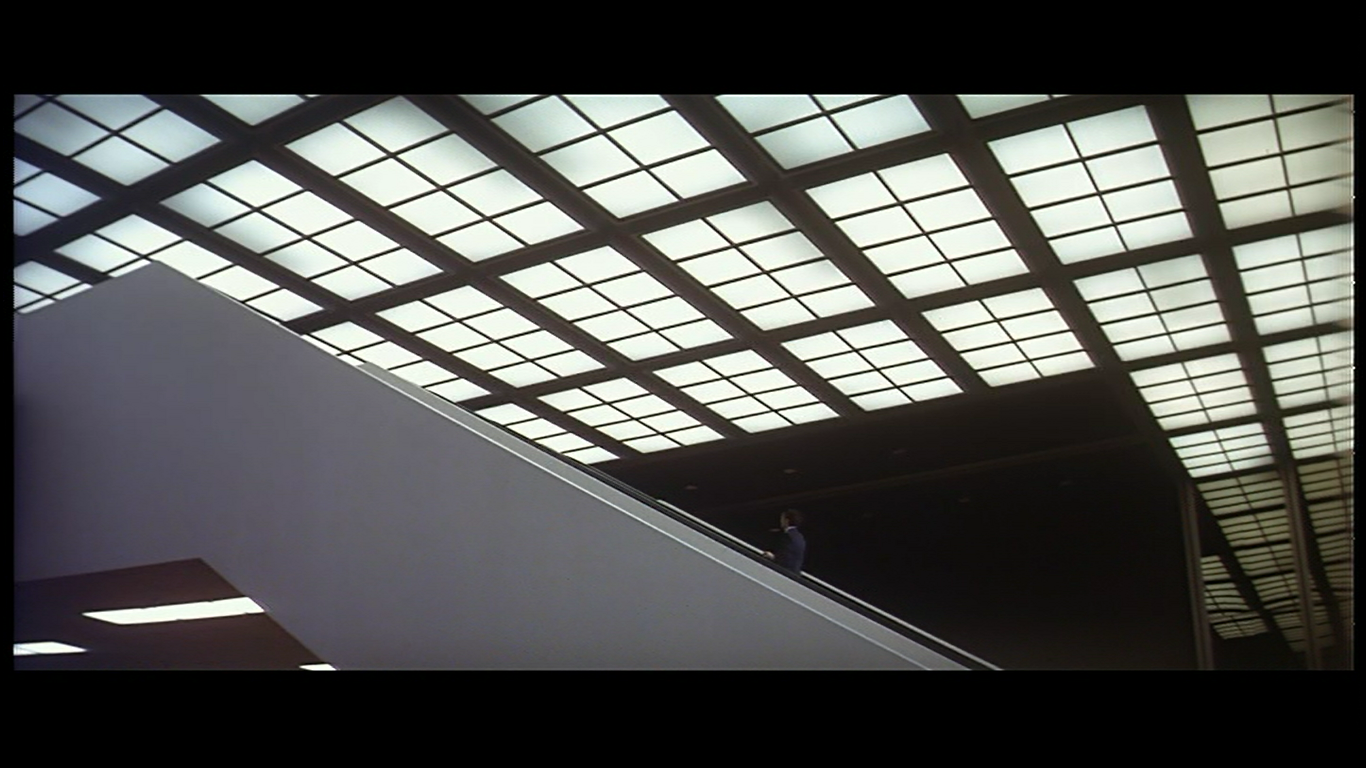
The film was a gift for the DOP - loads of widescreen exterior scenes with forbidding modernist architecture, and dimly lit, labyrinthine interiors.


Warren Beatty played a good roaming journalist trying to uncover the reason why all of the witnesses to the initial assassination have died in suspicious circumstances. This involved a lot of snooping through drawers, talking to psychoanalysts with chimpanzees on their lap, getting into one hell of a contrived bar room brawl and subsequent car chase, and then more snooping around in imposing office blocks...


I'm not sure it's the minor masterpiece that some hold it up to be. Much of the atmosphere of the film was simply that - atmosphere: no payoff. And for as much as I enjoy ambiguous scenarios I would like to have had a little more insight into why the Parallax organisation were killing people, and who, if anyone, employed them. Without any rigorous intellectual questions the lack of further explanation of the plot does feel like a kop-out. Antonioni could have made it better.... In fact he did with Blow-up and The Passenger.


Monday, 8 November 2010

Network (1976)

Another mid 70s American film. There's something about that grainy, washed out film stock and the convergence of fading Hollywood stars and young upstarts that really appeals.

Network is a much talked about film, mainly due to the frenzied rages of Peter Finch's doom-mongering newscaster Howard Beale and his cry of 'I'm mad as hell and I'm not going to take it anymore!' He's fired from the network due to failing viewing figures, but after he announces he' going to kill himself on air the figures start to climb. The network, desperate for the share of the audience eggs him on, puts him on prime time with a blank canvas and the nation becomes hooked on the ravings of this late middle-aged man who has got sick of the bullshit.


Then there is leather faced William Holden who plays his old boss and the only person who seems to have his interests at heart. He's having a fling with Faye Dunaway's ambitious programming director, who in turn takes advantage of Finch's rants and put him centre stage on the networks listings.
Robert Duvall puts on his bombastic, face rubbing act and really attacks the screen with his bullish network chief. An opportunist with some killer lines ("That's a big fat, big titted hit!") Duvall is the best thing in the film next to Finch.


Paddy Chayefsky won the Oscar for his screenplay and deservedly so. Its a stagey, overwritten and unrealistic script, but one that is suited to such an outrageous scenario. You could never accuse Network of realism. Insider jokes abound: especially funny are the programme pitches Dunaway has to sift through every morning, most of which involve a "crusty yet benign older man working with a brilliant, beautiful woman. S pointed out that this could equally be said of Dunaway and Holden - whether this was deliberate irony or just sloppy writing, I couldn't help seeing their relationship as the weak link, a magnet to get ticket sales at a time when Faye Dunaway was a big box office draw. 


Lumet excels at this kind of picture, withdrawn and observant, allowing his actors range to express themselves (or overact) and somehow managing to make great entertainment out of a bunch of cold characters. An enjoyable and highly prescient film, it seems that there has never been a time since its release that Network could not be held up as a mirror to the current era's television addiction.